
Managing a restaurant in 2026 means answering a lot of questions. Five years ago, a diner might have asked if the fish was fresh; today, they want to know which port it landed in and whether the harvester was paid a living wage. This shift has forced sustainability out of the marketing department and directly into the heart of the kitchen’s tech stack.
For most operators, terms like ‘blockchain’ and the ‘Internet of Things’ (IoT) sound like they belong in a Silicon Valley boardroom, not a busy walk-in. But beneath the technical jargon lies a very practical set of tools that help you solve two of your biggest headaches: proving your sourcing claims to skeptical guests and stopping the ‘invisible leaks’ in your utility and food costs.
The New Standard of Traceability: Blockchain
Think of blockchain as a digital passport for your ingredients that can’t be forged. Unlike a traditional paper trail or an Excel spreadsheet that can be edited with a few keystrokes, blockchain is an immutable ledger. Once a piece of data – like a harvest date or a farm location – is logged, it’s locked in.
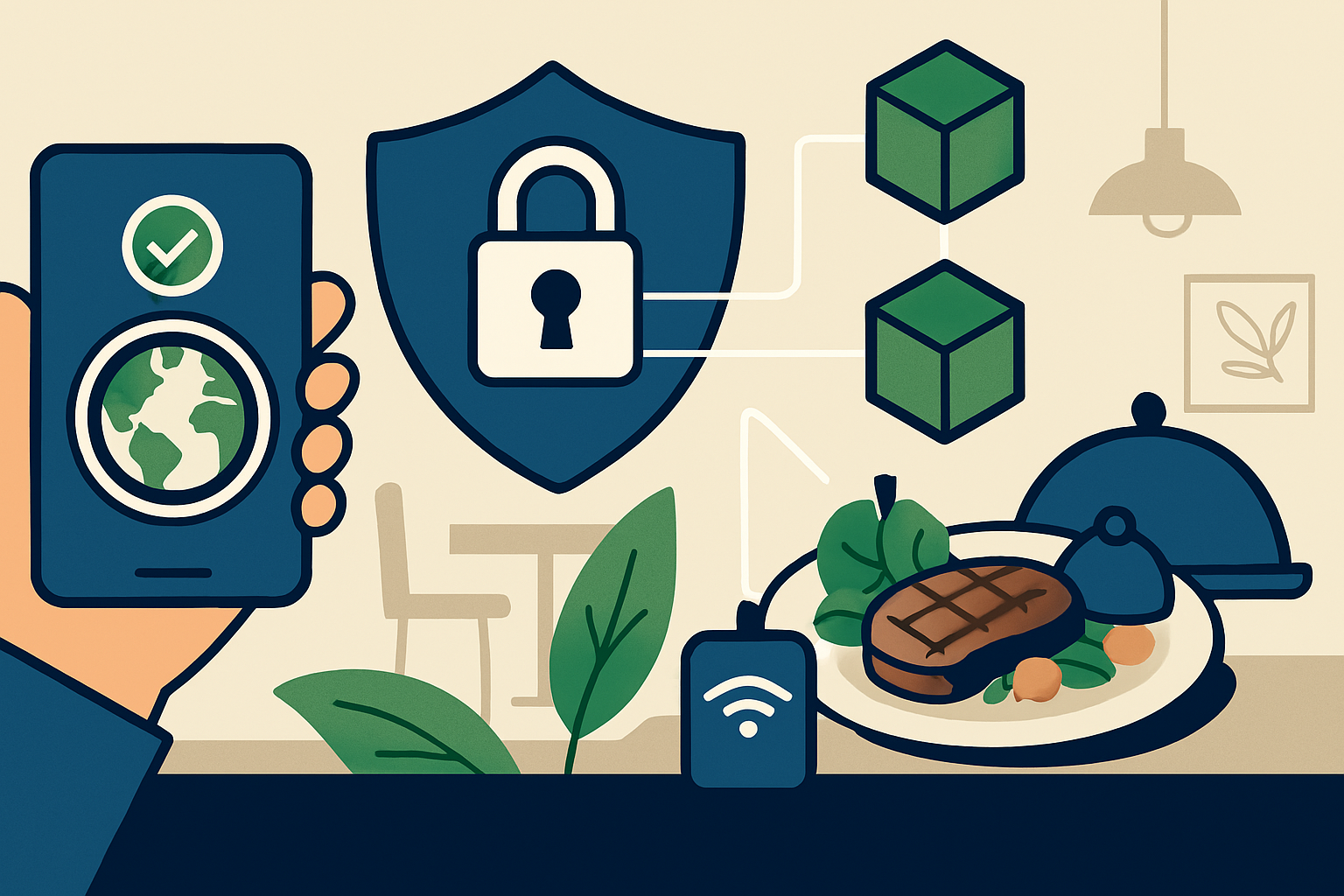
For a restaurant manager, this bridges the ‘trust gap.’ If you’re paying a premium for grass-fed beef or heirloom tomatoes, you should be able to prove that value. When guests scan a QR code on your menu, they aren’t seeing a generic marketing blurb; they’re seeing a verified record of that specific shipment’s journey.
As noted in a recent scenario analysis on restaurant blockchain adoption, this technology is moving beyond simple tracking to create a verifiable record of food safety and handling. This doesn’t just build trust; it protects your brand by allowing you to identify the exact source of a contaminated product in seconds rather than days.
The Pulse of the Kitchen: IoT and Real-Time Data
If blockchain is the record-keeper, IoT is the nervous system. IoT refers to the network of smart sensors throughout your operation – inside your refrigerators, on your delivery crates and even attached to your grease traps.
These sensors provide the ‘ground truth’ for your sustainability goals:
- Cold chain integrity: Sensors monitor temperatures during transit. If a truck’s refrigeration dips for twenty minutes, the system logs it automatically, allowing you to reject compromised stock before it hits your prep table.
- Energy management: Smart meters identify ‘energy vampires,’ showing you exactly which piece of equipment is drawing excessive power during off-hours, helping you trim your utility bills.
- Precision waste tracking: IoT-enabled scales can categorize what is being thrown away, helping chefs adjust prep lists to minimize food waste before it happens.
According to the 2026 Restaurant Readiness Report, 63% of operators believe that real-time visibility into energy and equipment usage is now essential for meeting sustainability goals while protecting margins in a high-inflation environment.
Case Study: Connecting the Dots
Let’s look at how these technologies actually look in a Saturday night service:
- At the farm: An IoT sensor in a hydroponic lettuce farm records water usage. This data is uploaded to a blockchain ledger.
- During transport: An IoT tag on the crate monitors temperature. This ‘hand-off’ is recorded as a ‘smart contract’, verifying the quality upon arrival at your loading dock.
- In your restaurant: The chef uses an IoT-connected scale to track trim waste. The data shows that switching to this specific farm has decreased your food waste by 12% because the product arrives fresher.
- For the guest: The diner scans the QR code on their salad. They see the farm’s location, the date it was picked and the verified carbon footprint of the delivery.
Why Operators are Investing Now
There is also a significant legal push behind this. With the FDA’s FSMA 2026 regulations in effect, restaurants are required to provide verifiable data records for ‘Critical Tracking Events’ in the food chain. Manual logs are no longer sufficient to meet these federal standards; IoT and Blockchain automate this compliance, saving you from a mountain of paperwork.
Practical First Steps
You don’t need to rebuild your entire operation overnight. Most independent restaurants find success starting small:
- Step 1: Automated temperature monitoring. Ditch the clipboards and put smart sensors in your walk-ins to prevent overnight spoilage.
- Step 2: Partner with tech-forward vendors. Ask your suppliers if they provide blockchain-verified data that you can link to your digital menus.
- Step 3: Equipment audits. Put smart plugs on your oldest, highest-draw appliances to see if they are costing you more in electricity than they are worth in production.
Ultimately, sustainability tech isn’t about jumping on a bandwagon or using the latest gadgets for the sake of it. It’s about having the data to back up your promises. When you can show a guest exactly where their food came from and show your accountant exactly where your energy costs are going, you’re not just being eco-friendly, you’re being a better operator.