
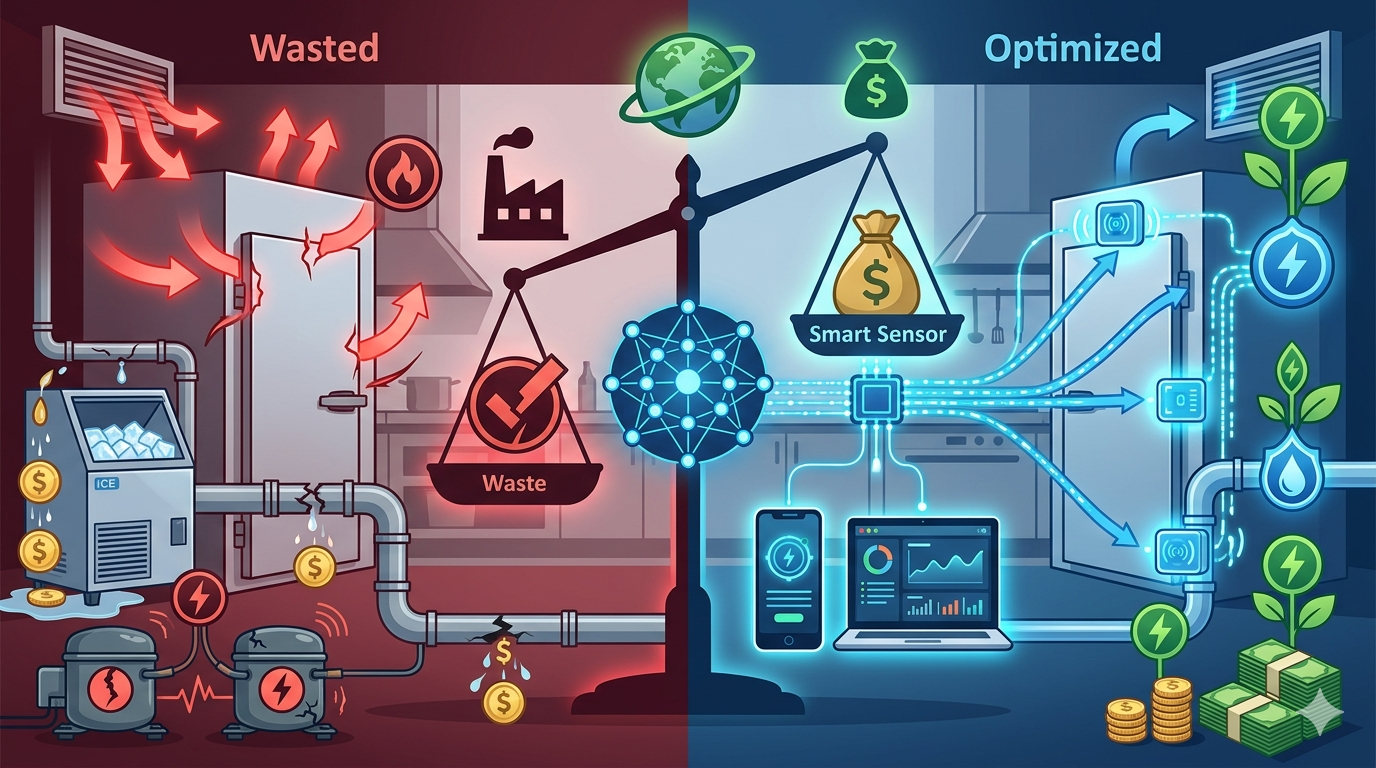
In the fast-paced world of restaurant management, the “invisible” costs are often the ones that bite the hardest. We aren’t just talking about the price of avocados spiking or an unexpected labor shortage. We’re talking about the silent hum of walk-in compressors running 24/7, the slow drip of a leaky pipe behind the ice machine, and the HVAC system pumping air into an empty dining room at 3:00 AM.
Historically, utility bills were viewed as a fixed cost, a necessary evil of doing business. But as we navigate 2026, a technological shift is occurring. Sustainability has moved out of the marketing department and directly into the kitchen’s tech stack. By leveraging the Internet of Things (IoT), restaurant operators are transforming their back-of-house from a black hole of energy consumption into a streamlined, data-driven profit center.
The “Visibility Gap”: Why Your Monthly Bill is Too Late
The fundamental problem with traditional utility management is that it’s reactive. You receive a bill three weeks after the waste has occurred. If a freezer seal was compromised or a water valve was stuck open, you only find out when the financial damage is already done.
IoT sensors close this “visibility gap.” These small, wireless devices act as a nervous system for your restaurant, monitoring electricity, water and gas usage in real-time. According to recent data on smart monitoring trends, operators are now able to identify preventable waste that accounts for 25% to 40% of their total utility expenses.
1. Smart Refrigeration: Protecting Your Cold Chain and Your Cash
Refrigeration is the single largest energy consumer in most kitchens, often accounting for nearly half of a restaurant’s electric bill. It’s also the highest risk factor for food safety.
Beyond temperature logs
While manual temperature logs are a health department requirement, they are woefully inadequate for energy management. An IoT sensor doesn’t just record a number; it analyzes the “health” of the unit.
- Compressor health: Is the motor running longer cycles than it did last month? This is often a sign of failing components or dirty coils.
- Door events: Sensors can alert managers if a walk-in door hasn’t been closed properly or if it’s being opened too frequently during prep, allowing cold air to escape.
- Predictive alerts: Before a unit fails and spoils $5,000 worth of Wagyu beef, the sensor detects the slight temperature climb, sending an alert to your phone.
Research highlights that IoT kitchen monitoring can prevent up to 96% of equipment failures by catching these anomalies hours or even days before a total breakdown occurs.
2. HVAC Optimization: Conditioning for People, Not Empty Space
Heating, Ventilation and Air Conditioning (HVAC) systems are the second-largest utility drain. In many restaurants, these systems are set to a fixed schedule that doesn’t account for the actual “pulse” of the restaurant.
Adaptive climate control
By integrating occupancy sensors and smart thermostats, the kitchen can “talk” to the HVAC. If the dining room is empty between 2:00 PM and 4:00 PM, the system can automatically adjust the set point. More importantly, smart kitchen hoods can now detect smoke and heat levels, ramping up fan speeds only when active cooking is happening, rather than running at full blast from open to close.
In a high-inflation environment, this level of precision is essential. Industry reports like the 2026 Restaurant Readiness Report show that over 60% of operators now view real-time visibility into equipment usage as a “must-have” to protect their margins.
3. Water Intelligence: Detecting the Invisible Leak
Water is often the most overlooked utility, yet it can cause the most catastrophic damage. A single major leak can lead to property damage averaging $89,000, not to mention forced closure and lost revenue.
IoT water flow sensors are placed strategically behind high-risk areas like dishwashers, ice machines and under sinks.
- Micro-leak detection: These sensors can detect a “trickle” that is too small for a human to notice but adds up to hundreds of gallons over a month.
- Automated shut-offs: Advanced systems can even shut off the main water valve automatically if a catastrophic burst is detected after hours, saving the kitchen floor from becoming a swimming pool.
The Strategic Payoff: Sustainability is Profitability
The “S” word – Sustainability – can sometimes feel like an expensive goal. But in the IoT era, being “green” is simply the byproduct of being a sharp operator. When you reduce your energy waste, you aren’t just lowering your carbon footprint, you are directly injecting that saved cash back into your EBITDA.
Implementation: Start Small
You don’t need to overhaul your entire kitchen overnight. Most successful operators follow a tiered approach:
- Tier 1: Install wireless sensors in walk-ins and freezers to prevent spoilage.
- Tier 2: Add water leak detectors in high-risk zones.
- Tier 3: Use smart plugs and sub-meters on high-draw appliances (like fryers and ovens) to identify “energy vampires” during off-hours.
Conclusion
The restaurants that thrive in 2026 will be those that treat their utilities with the same scrutiny as their food costs. IoT-driven sustainability offers a rare win-win: it protects your equipment, ensures food safety compliance and significantly slashes your overhead. In an industry where margins are famously thin, the data coming from your smart sensors might just be the most valuable ingredient in your kitchen.