
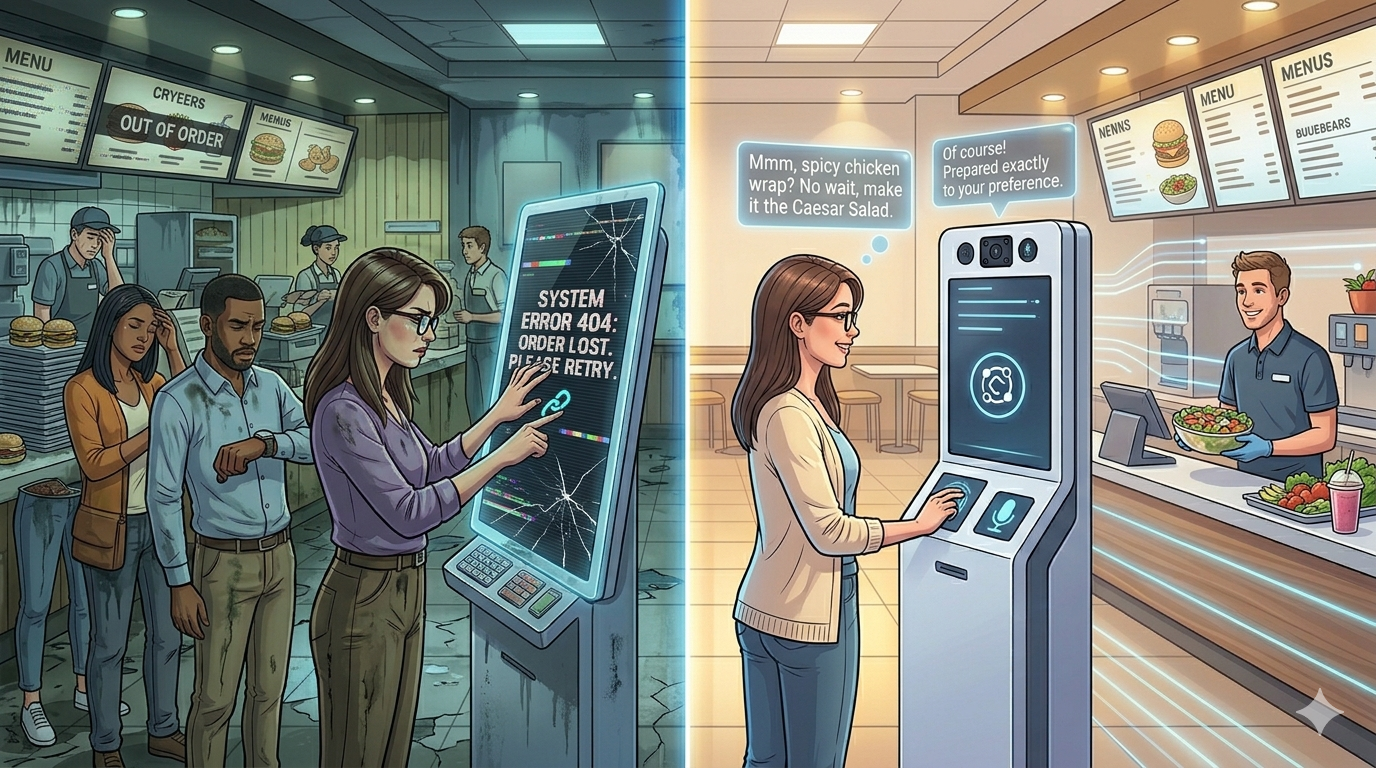
Walk into almost any quick-service restaurant today and the self-service kiosk is no longer a novelty; it is a permanent fixture. But let’s be brutally honest about the current hardware sitting in most lobbies. It is essentially a giant tablet running on glass-tapping mechanics designed a decade ago. Guests still stand there, squinting at modifiers, manually scrolling through hundreds of ingredients, and tapping the screen dozens of times just to remove onions from a burger.
That isn’t a digital revolution; it is just shifting the labor of data entry from your cashier to your customer.
The next frontier of quick-service operations is aggressively moving away from physical contact and clunky navigation. By combining voice-activated ordering with opt-in facial recognition, forward-thinking brands are shifting from a passive “touchscreen menu” to an active, predictive interface. For operators, this isn’t about looking like a sci-fi film, it is a calculated play to slash ordering friction, maximize throughput during peak rushes and unlock unprecedented check sizes.
The Friction Problem: Why Glass Tapping Has Hit a Wall
The primary goal of any self-service kiosk is speed and accuracy. Yet, complex menus with deep customization options often stall the line. A guest who wants to make three modifications to a combo meal can easily get bogged down in sub-menus, creating a digital bottleneck that mimics the counter lines kiosks were supposed to eliminate.
Furthermore, loyalty program adoption remains a persistent hurdle. Asking a customer to manually type in a 10-digit phone number or fumble around to scan a QR code from a mobile app while a line forms behind them introduces immediate transaction friction. If the process takes too long, they simply skip it and you lose the data.
Biometric Loyalty: The Three-Second Check-In
Integrating opt-in facial recognition completely reshapes the entry point of the transaction. Instead of forcing the guest to manually declare who they are, a camera mounted on the kiosk recognizes their face as they step up, immediately pulling up their profile.
Integrating advanced biometrics allows systems to automatically load customized user preferences and loyalty rewards instantly.
Consider the operational velocity this unlocks:
- Instant verification: The system greets the guest by name and securely pulls up their historical data.
- The “Order the Usual” shortcut: A prominent button appears saying, “Welcome back, David. Do you want your usual Spicy Chicken Combo with an Iced Tea?”
- Seamless payments: Secure biometric authentication can link directly to a saved mobile wallet or payment token, allowing the customer to approve the charge with a single nod or glance.
By compressing the identification, ordering and payment phases into a seamless, three-second interaction, operators can drastically reduce total transaction times and process significantly more orders during critical peak hours.
Conversational Voice AI: Natural Language Meets Predictive Upselling
While facial recognition handles the “who”, voice activation transforms the “what”. Instead of navigating a visual maze of buttons, a guest simply speaks to the kiosk exactly as they would to a human cashier: “Give me a double cheeseburger with no pickles, extra fries and a large diet cola.”
Using advanced natural language processing (NLP), modern voice engines can parse complex, unscripted sentences instantly, accurately executing modifications on the fly. This capability completely changes accessibility for visually impaired guests or those intimidated by complex digital layouts.
However, the real operational magic happens when voice interfaces couple with predictive AI engines. The industry has reached a pivotal tipping point where AI automation seamlessly drives real-time upselling at scale. Unlike a tired teenager working a cash register on a Friday night, a voice-activated kiosk never forgets to upsell, and it does so intelligently:
[Guest Speaks] -> “I’ll take the Crispy Chicken Sandwich.”
[Kiosk Analyzes] -> (Checks time of day, current weather and local kitchen inventory)
[Kiosk Voice Responds] -> “You got it. Want to make that a meal with our seasoned curly fries and a hot coffee since it’s raining outside?”
This nuanced approach to upselling feels helpful rather than pushy, consistently driving a 15% to 30% increase in average ticket sizes without adding a single dollar to your front-of-house labor costs.
Navigating the Implementation: Privacy and Operations
Transitioning to these advanced interfaces requires a deliberate approach, particularly regarding guest privacy and data security. Operators looking to pilot this technology must keep three core principles in mind:
Strictly opt-in mechanics
Facial recognition must never feel covert. It should be explicitly presented as a premium, opt-in convenience tool linked to your loyalty rewards program. Guests who prefer traditional navigation must always have the option to use standard touch controls or voice commands without biometric scanning.
Localized security frameworks
Ensure your technology vendors utilize encrypted payment tokens and secure identity resolution rather than storing raw facial images on local servers. Compliance with regional data protection laws is non-negotiable.
Strategic staff redeployment
Kiosks do not replace your team; they reallocate them. By moving your staff away from the mechanical task of inputting orders, you can transition employees into “guest experience hosts” who manage order handoffs, keep dining rooms pristine and step in to assist guests who need help navigating the new hardware.
The New Baseline of QSR Efficiency
The line separating cutting-edge quick-service operations from lagging concepts is no longer defined by whether you have digital menus. It is defined by how smoothly you remove the invisible hurdles between a hungry guest arriving and their food hitting the tray.
Voice and biometric kiosks represent a fundamental shift from reactive ordering tools to proactive hospitality assets. By automating the mechanical data entry of an order and infusing it with predictive personalization, you maximize kitchen throughput, elevate your team’s operational focus and build a highly accurate, high-margin transaction loop that outpaces the competition.