
Let’s have a quick moment of honesty. How many times this week have you blasted your entire email list with a “15% off Tuesday night dinners” promo?
We’ve all done it. It’s the classic, comforting panic button we hit when covers look low. But let’s look at what that blast actually achieves. Your die-hard regulars — the ones who would gladly pay full price — snag the discount. Meanwhile, the lapsed guests who moved across town completely ignore it and your overall profit margins take a painful hit.
In today’s ultra-competitive environment, blanket discounts are actively hurting your bottom line. Consumers are tightening their belts, yet their expectations for digital experiences have skyrocketed. According to recent insights on 2026 restaurant technology trends from Tillster, guests are becoming hyper-selective, judging value not just by price, but by how frictionless, personalized and reliable their interactions are.
If you want to keep your tables full without destroying your margins, it’s time to move past mass promos and embrace true 1:1 personalization. And the secret weapon making this possible right now? The Composable Customer Data Platform (CDP).
The Big Data Mess: Why Your Systems Aren’t Talking
Before we talk about the solution, let’s look at the root of the headache. On any given Friday night, your restaurant is swimming in guest data. The problem is that it’s trapped in a dozen different silos:
- System A (your POS): Knows that someone bought a spicy tuna roll and a draft beer.
- System B (your loyalty app): Knows a user has 450 points but hasn’t ordered in three weeks.
- System C (your reservation software): Knows a party of two always requests a booth near the window.
- System D (your third-party delivery): Knows an address orders a family-sized pepperoni pizza every Sunday.
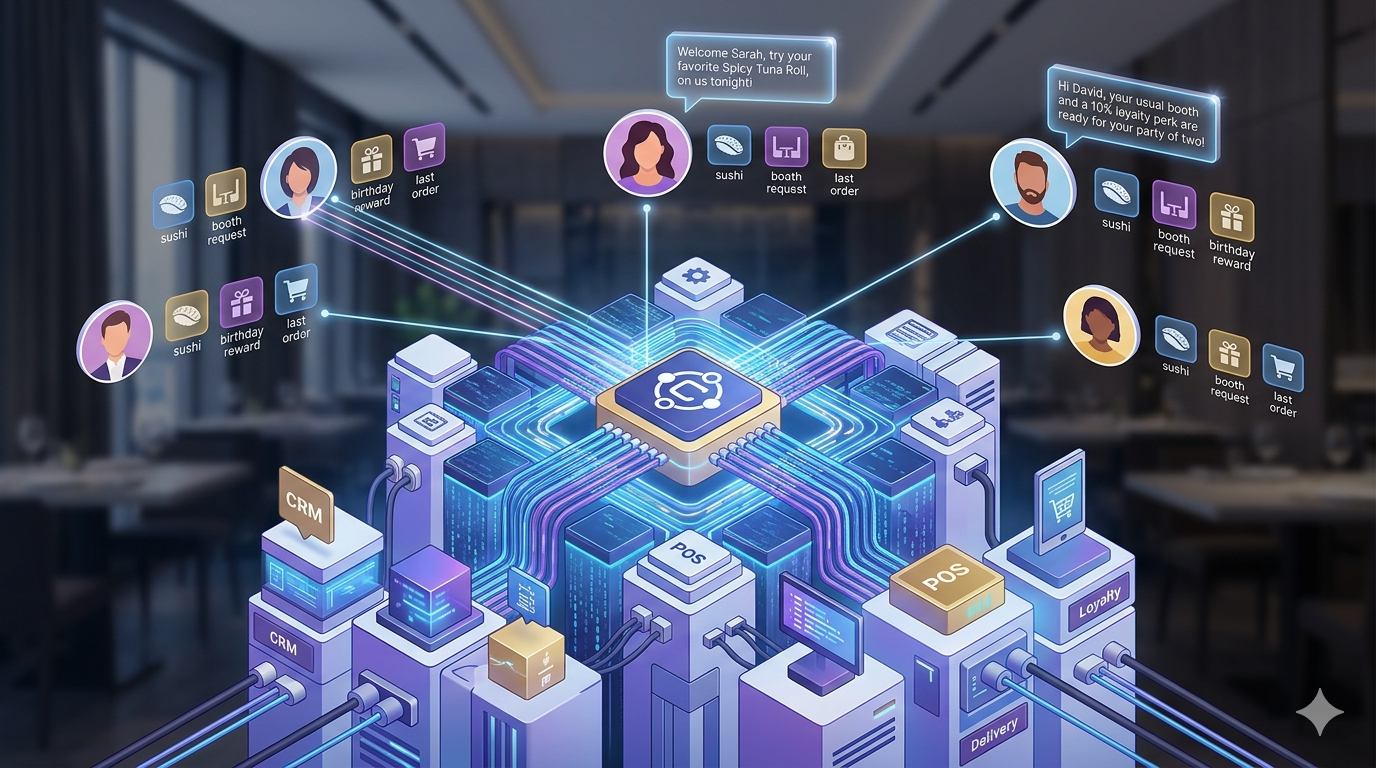
To your tech stack, this looks like four completely different people. In reality, it’s just one loyal guest named Sarah. Because your systems are blind to each other, Sarah gets an email promoting a steak night when she’s actually a vegetarian who only orders sushi.
Enter the Composable CDP: Your Digital Matchmaker
Traditionally, fixing this meant buying a massive, rigid, “all-in-one” legacy Customer Data Platform. These systems are notoriously expensive, take months to set up and force you to move all your data into their ecosystem. For independent operators and growing mid-sized chains, it’s a total headache.
A composable CDP changes the game entirely. Instead of moving your data to a new home, it plugs directly into your existing data infrastructure (like your cloud warehouse) and connects the dots right where they are. It acts as a modular translator, pulling behavioral data from your app, transaction data from your POS and booking data from your reservation engine to build a single, unified profile for every guest.
As highlighted in CDP.com’s comprehensive QSR CDP guide, identity resolution is a major win here. When you can stitch together loyalty IDs, payment tokens and email addresses, brands typically see a 25% to 40% increase in their identified customer base. Suddenly, you actually know who is buying your food, how they pay and what they love.
What 1:1 Personalization Looks Like in Action
Once your composable CDP unifies your data, the magic happens. You stop guessing and start anticipating. Instead of blasting your entire database, you can automatically trigger hyper-targeted, margin-friendly actions based on real behavior.
Here are a few ways operators are winning with this strategy:
1. The “daypart migration” play
Do you have a crowd of regular guests who only visit for breakfast or a morning coffee run? A composable CDP can flag these high-propensity targets and automatically send a personalized text message offering a perk on a mid-week lunch sandwich. You are expanding their buying habits without giving away discounts on the breakfast they were already going to buy.
2. The smart reactivation
Instead of emailing a generic “We miss you” coupon to thousands of people, your system can identify a guest who used to order a specific craft burger every Friday but hasn’t visited in 30 days. The automated trigger? A personalized note: “Hey Alex, we just tapped a fresh keg of your favorite IPA. Come in this weekend and your first pour is on us when you grab your favorite burger.” It’s highly relevant, feels human and drives immediate action.
3. The margin-safe VIP experience
Your highest-value regulars don’t need a 20% off coupon to show up — they already love you. Instead of discounting their bill, use your CDP data to surprise and delight them. Flag their profile so that when they check in, the host hooks them up with their preferred booth or the kitchen sends out a complimentary dessert they’ve never tried before. You build fierce loyalty without stripping away your top-line revenue.
Future-Proofing Your Hospitality
The gap between technology-forward restaurants and traditional concepts is widening fast. As outlined in industry forecasts from QR Menu Generator, generic dining experiences are quickly feeling outdated to modern consumers. Moving toward data integration isn’t about replacing the human element of hospitality, it’s about empowering it.
When your tech stack automatically takes care of the segmentation and heavy lifting, your front-of-house team can focus entirely on what they do best: taking amazing care of the guests standing right in front of them.
Stop throwing money at mass promotions that devalue your brand. Look into how a modular, composable approach to your data can help you treat every single guest like a regular. Your margins — and your guests — will thank you for it.