
Remember a couple of years ago when the restaurant industry went absolutely wild for voice AI? Headlines promised a world where an artificial intelligence bot would flawlessly answer every ringing phone and handle every drive-thru order, completely solving the labor crisis overnight.
Fast forward to today and if you’ve actually tried running one of those early, fully autonomous systems, you know the reality was a little more… chaotic.
We all watched the viral videos of AI drive-thrus accidentally adding hundreds of chicken nuggets to a single order because a child was screaming in the backseat. It turns out that while natural language processing is incredibly smart, it still gets deeply confused by a lawnmower driving past the speaker box, a guest with a thick regional accent or someone changing their mind three times mid-sentence.
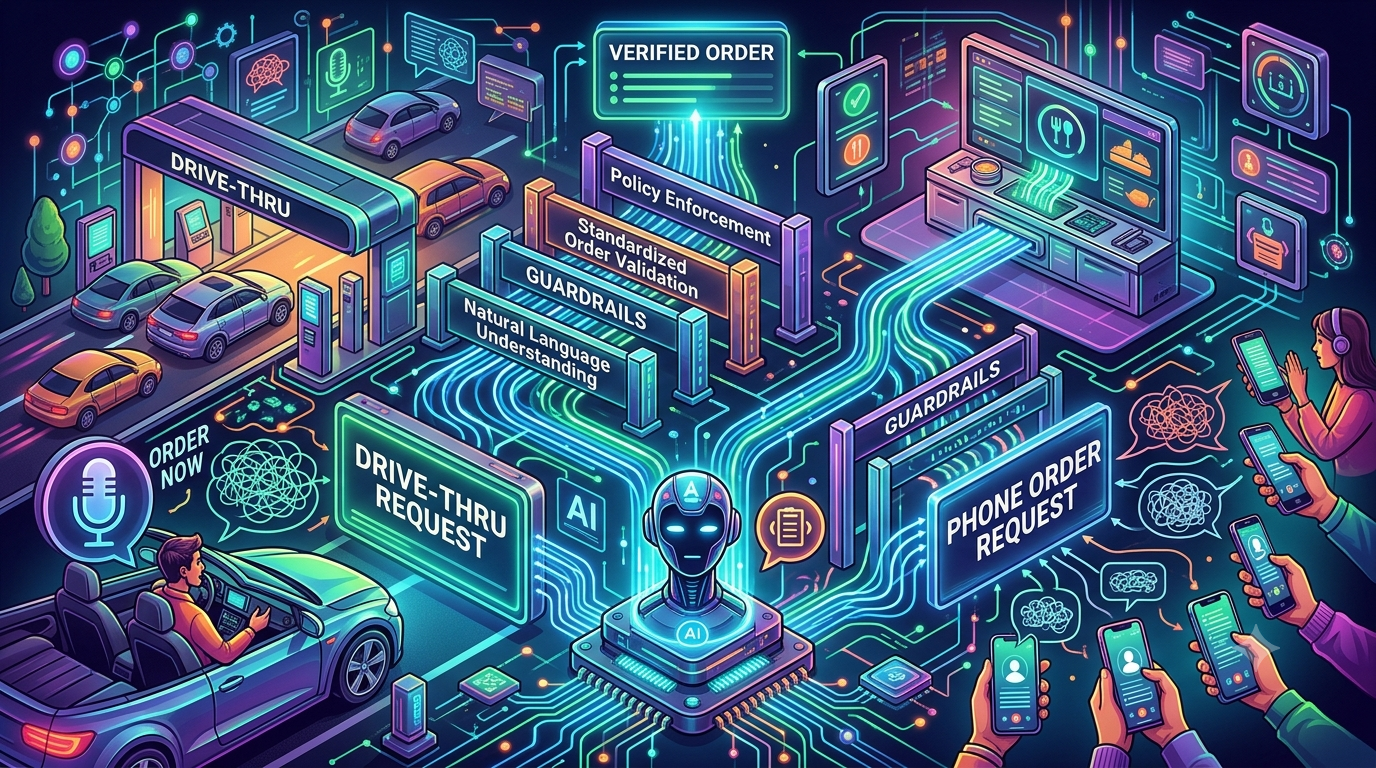
Because of those bumpy rollouts, a massive trend has quietly taken over: voice-AI guardrails or what the tech world calls “Human-in-the-Loop” (HITL) systems. Instead of leaving the AI alone in the wild, operators are pairing it with a silent safety net.
Let’s break down how this works, why it’s saving restaurant margins and how it actually plays out on a busy Friday night.
What on Earth is a Voice-AI Guardrail?
Think of a voice-AI guardrail like a driving instructor sitting in the passenger seat with a dual set of brakes. The AI is behind the wheel — greeting the customer, taking the order and doing the heavy lifting. But a human agent is silently listening in the background, ready to nudge the system if it veers off course.
According to a comprehensive breakdown of restaurant AI on MenuThere, voice ordering is one of the top three ways operators are scaling AI. However, it’s also notorious for high “pause and rethink” rates. That’s where the human backup loop comes in. The customer thinks they are having a seamless, uninterrupted conversation with an incredibly fast bot, but behind the scenes, a human operator is correcting typos or clarifying modifications in real-time before the order even hits your kitchen’s POS screen.
Scenario A: The Drive-Thru “Toddler Typhoon”
To see this in action, let’s look at a hypothetical lunch rush at a busy fast-casual spot.
A minivan pulls up to the speaker box. Inside is a stressed parent and two toddlers who are actively debating the merits of various cartoon characters at the top of their lungs.
Diner: “Hi, I’d like a number three with a diet… SHUSH, Leo, mommy is talking!… sorry, a diet cola, wait no, make that an iced tea. And a kids’ meal with apple slices… NO, I WANT FRIES!… okay, scratch the apples, give me fries.”
An unassisted AI chatbot might completely panic here, entering a diet cola, an iced tea, apple slices and a side of fries, all while trying to interpret “SHUSH, Leo” as a premium mod.
With a guardrail system in place, the AI captures the audio, but an off-site human reviewer sees the messy transcription popping up on their dashboard. With a couple of rapid clicks, the human deletes the “diet cola,” swaps the apples for fries, silences the background noise and approves the clean text. The AI smoothly responds to the parent: “Got it, so that’s one number three with an iced tea and a kids’ meal with fries. Would you like to add an apple pie today?”
The parent gets exactly what they wanted, the order is perfectly accurate and your kitchen staff never had to click a single button or strain their ears to hear over the screaming toddlers.
Scenario B: The Friday Night Call-In Chaos
Now let’s look at phone orders. We know that missing phone calls is a massive drain on top-line revenue. In fact, a recent report by Hostie AI indicates that implementing voice AI can cause an 87% reduction in missed calls, driving up reservation conversions and order captures significantly.
But what happens when someone calls your pizza shop from a noisy sports bar?
Diner: “Yeah, I need a large pepperoni… hold on, turn that down!… a large pepperoni, but put mushrooms on half. Wait, can you do gluten-free crust on that? Actually, forget it, just regular crust, but make it double well-done.”
This is a nightmare sequence for basic automated voice bots. The phrase “gluten-free crust… actually, forget it” often results in the restaurant making an expensive gluten-free pizza that the guest rejects at pickup.
With a hybrid system, vendors can utilize live agents who monitor complex customizations. If the AI wavers on whether the user meant “gluten-free” or “regular,” the human validator instantly clicks “regular crust” and flags the “double well-done” instruction. The line cook gets a perfect ticket and the manager doesn’t have to deal with an angry customer at the register.
Why Operators Love the Hybrid Approach
If you’re wondering why you should pay for an AI tool that still requires a human eye, it all comes down to the math of labor and order accuracy.
1. Massive labor leverage
You aren’t hiring a dedicated employee to sit there and listen to one speaker box. A single off-site human guardrail agent can monitor up to 20 to 30 lanes or phone lines simultaneously because they only intervene when the AI flags a “low confidence” score. You get the labor-saving benefits of automation without losing the safety net of human judgment.
2. Guarding the gate on accuracy
Data from the Annual QSR Drive-Thru Report showed that when a human steps in to assist a voice-AI system, order accuracy shoots up to a staggering 95%. In a world where food costs are sky-high, eliminating remake waste from misunderstood orders directly protects your bottom line.
3. Stress relief for your in-house crew
When your staff doesn’t have to sprint to answer a ringing phone or stand by the drive-thru window listening through static, they can focus entirely on the physical guests standing right in front of them. It reduces kitchen burnout, lowers turnover and speeds up your total ticket times.
The Takeaway
The dream of fully autonomous, zero-human-intervention voice AI isn’t dead, it’s just evolving. Right now, the smartest way to scale your operations, capture every single phone order and speed up your drive-thru lanes is to embrace the hybrid model.
By letting AI handle 90% of the conversation and keeping a human hand on the guardrails, you get the best of both worlds: unbeatable tech efficiency with a necessary touch of human common sense.