
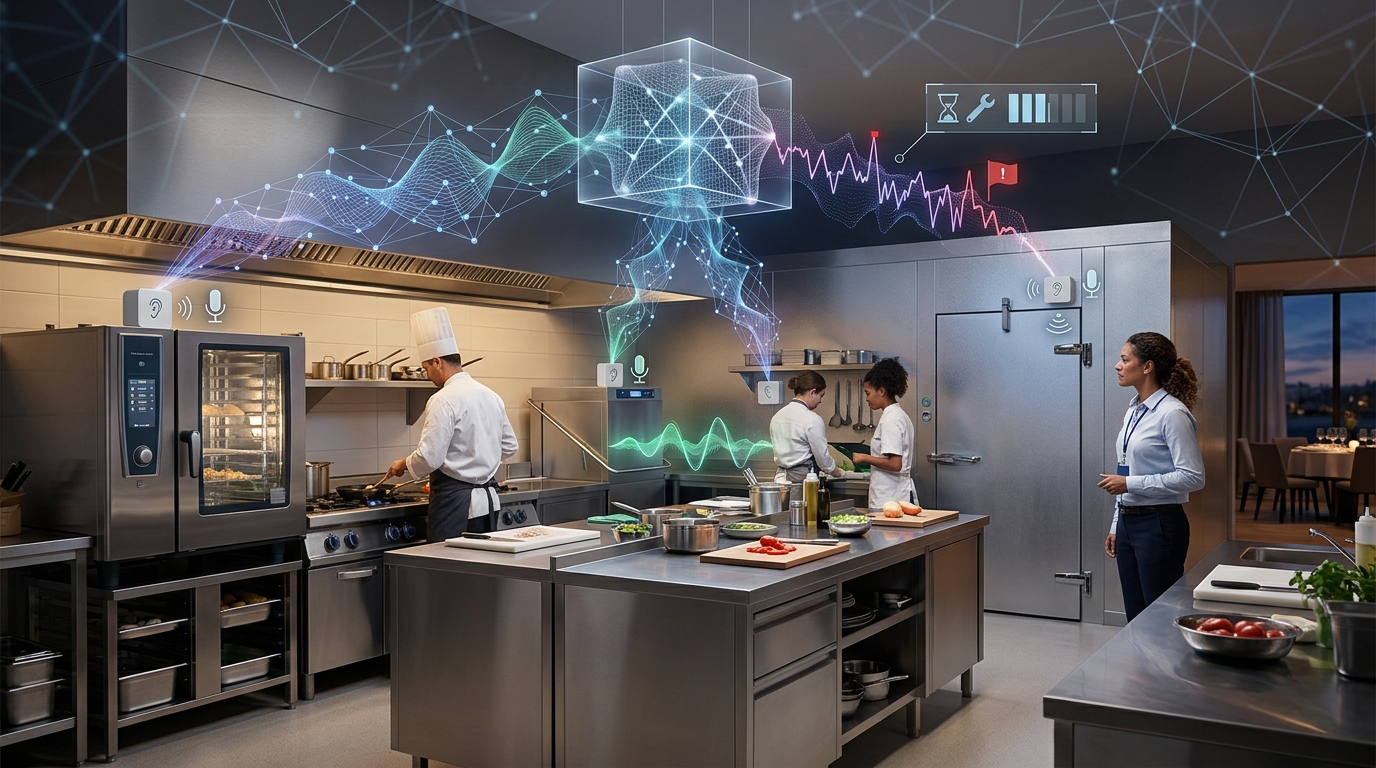
It is 7:15 PM on a Friday. The dining room is packed, ticket orders are printing off like receipts at a grocery store and the line cooks are moving with surgical precision.
Then, you hear it.
It starts as a faint, metallic clack-clack-clack, morphs into a wet grinding sound and ends with a dramatic pop. Your walk-in cooler’s compressor just went into cardiac arrest. Within hours, thousands of dollars worth of aged ribeyes, house-made sauces and fresh produce will start sweating in a rising heat zone.
Every restaurant operator has lived a version of this horror story. For years, the industry’s response to commercial kitchen maintenance has been purely reactive: If it ain’t broke, don’t fix it; if it is broke, panic and pay the weekend emergency service fee.
Even with the rise of basic IoT sensors, most tech solutions only tell you when a walk-in has already lost temperature. By then, the clock is ticking and your profit margins are melting.
Enter the newest, slightly weirdest frontier in kitchen management: Predictive Acoustic AI. Instead of waiting for a machine to overheat or die, we’re now sticking tiny, ultra-sensitive microphones onto kitchen equipment so artificial intelligence can literally listen to your appliances get sick.
Wait… You Want Me to Wire My Kitchen for Sound?
Not for music, no — though your line cooks would probably appreciate better speaker systems.
Acoustic AI relies on continuous acoustic monitoring to track the sub-audible “sound signatures” of mechanical parts.
Here’s the thing about heavy-duty kitchen equipment: before a motor burns out, a bearing seizes or an exhaust fan balance wobbles out of alignment, the machine changes pitch. Long before a human ear can detect it — and weeks before the machine actually stops working — friction, micro-cracks and pressure shifts create unique high-frequency sound waves.
Predictive acoustic AI sensors are non-invasive devices (often no bigger than a puck) that clamp onto the outside of your compressor, ice machine or HVAC unit. They capture those acoustic emissions, upload the audio telemetry to the cloud and run it through machine learning algorithms trained on thousands of hours of machine noise.
When your low-boy freezer’s motor starts singing out of key, the system flags it.
Instead of getting a panic-inducing alert at 8:00 PM on Friday reading:
🛑 WARNING: Walk-in temperature is 54°F.
You get a calm, civilized text on Tuesday morning reading:
🛠️ NOTICE: Fryer #2 exhaust motor bearing showing early acoustic friction. Schedule routine service within 14 days.
The Anatomy of a Kitchen Breakdown: What Acoustic AI Hears
To understand why this is a game-changer, you have to look at the usual suspects in your kitchen’s repair-and-maintenance budget.
1. The ice machine’s cryptic death rattle
Ice machines are notoriously finicky divas. Water scale builds up, pumps strain and water valves stick. An acoustic sensor glued near the water pump picks up ultrasonic friction changes caused by scale buildup weeks before the ice maker freezes over into a solid block of useless plastic.
2. The exhaust hood imbalance
Your kitchen hood system pulls grease and heat out of the building for 14 hours a day. When grease builds up unevenly on the fan blades, it throws off the motor’s center of gravity. You might not notice the subtle vibration, but acoustic AI captures the harmonic shift instantly. Catching it early prevents a blown fan belt or worse, a total motor burn-out that shuts down your cooking line because local fire codes won’t let you cook without ventilation.
3. Refrigeration compressor stress
Refrigeration systems don’t just “fail” out of nowhere. They suffer micro-leaks or electrical arcing over weeks. Acoustic sensors monitor the cadence of the compressor cycle. If the pump takes 12% longer to click off and sounds slightly strained, the AI registers a fault anomaly long before the ambient temperature shifts by even one degree.
Why Temperature Logs Are No Longer Enough
For decades, standard equipment management meant physical logbooks or, more recently, digital temperature probes. While temperature monitoring is essential for HACCP compliance, as an operational defense strategy, it’s remarkably late to the party.
Relying on temperature sensors to manage equipment health is like relying on a fever to diagnose an infection: it only alerts you when the system is already under severe stress. According to industrial predictive maintenance research, continuous acoustic and vibration monitoring catches early-stage mechanical failure modes long before thermal symptoms even register.
By shifting from reactive monitoring (temp logs) to predictive listening (acoustic AI), operators shift the power dynamic:
- No more emergency service rates: Calling a technician at 2:00 PM on a Tuesday costs a fraction of calling them out at 10:00 PM on a Saturday.
- Zero inventory losses: You repair the cooling unit while it’s still holding a rock-solid 36°F.
- Extended asset lifespan: Running a machine with a misaligned belt or a dry bearing destroys the entire motor housing over time. Fixing the small part early extends the total lifespan of a $10,000 piece of equipment by years.
How to Implement Acoustic AI Without an Engineering Degree
If you’re worried that deploying this technology requires rewiring your entire restaurant, deep breathe. Modern industrial condition-monitoring tools are built for easy retrofitting.
Here is how a practical rollout works for a restaurant operator:
- Target the top 20% risks: You don’t need a sensor on your toaster. Focus purely on high-consequence, high-cost assets: walk-in coolers, primary ice machines, main exhaust fan housings and rooftop HVAC units.
- Magnetic & adhesive mounting: Most modern predictive sensors require zero hardwiring. They attach magnetically or via industrial adhesive to the equipment casing.
- Set up smart alerts (not spam): Configure your system dashboard to send alerts only when an anomaly crosses a high-confidence failure threshold. Your goal is to give your facilities lead or general manager an actionable lead-time, not flood their phone with meaningless noise.
Listen Up: The Quiet Kitchen Revolution
Restaurant margins are squeezed tighter today than ever before. We analyze food costs down to the cent, obsess over labor hours and tweak menu prices constantly. Yet we still accept multi-thousand-dollar emergency equipment meltdowns as an “unavoidable cost of doing business.”
It doesn’t have to be.
Your kitchen equipment is already trying to tell you when it’s hurting. You just need to give your restaurant the ears to listen.