

A hungry diner opens ChatGPT or Perplexity on a Friday evening. They type: “Find me a casual seafood spot downtown with gluten-free options and outdoor seating for six.”
The generative engine responds instantly with a list of three spots. It highlights your restaurant, accurately praising your pan-seared sea bass.
Then it adds a fatal hallucination: “They offer half-price oysters every Friday night and feature a covered, heated patio.”
Except you don’t serve oysters. And you don’t have a patio.
Twenty minutes later, six guests arrive expecting discount shellfish on a cold night. When your front-of-house staff delivers the news, the guests leave furious, leaving a 1-star review on Yelp.
Welcome to the era of generative search hallucinations, where conversational AI engines quietly invent facts about your business, damaging your bottom line before you even know there’s a problem.
The Real Cost of Generative AI Hallucinations
Generative search engines do not operate like traditional web browsers. Instead of indexing pages and serving links, Large Language Models (LLMs) predict the most statistically probable sequence of words to answer a user’s prompt.
When an AI engine encounters missing, outdated or contradictory information across the web, it fills in the blanks with plausible-sounding guesses. In the tech industry, this is called a hallucination. In the restaurant industry, it is an operational nightmare.
These inaccuracies are not hypothetical edge cases. When AI search tools generated false promotions for Stefanina’s Pizzeria, staff members had to deal with angry patrons demanding nonexistent deals on large pizzas.
When AI lies about your restaurant, you face immediate friction:
- Host stand conflict: Staff wasting shift hours explaining why an AI-invented deal doesn’t exist.
- Wasted prep: Kitchens preparing for phantom party sizes or nonexistent menu demands.
- Brand erosion: Diners attributing AI mistakes directly to your management.
Conducting a Quarterly “AI Hallucination Audit”
Restaurant managers cannot afford to sit back and hope LLMs get their details right. Running a quarterly AI audit is now a fundamental operational standard. Here is how to audit what generative engines are telling your prospective guests:
1. Test key conversational prompts
Open the top four generative engines: ChatGPT, Perplexity, Google AI Overviews and Gemini. Test your venue using direct and indirect queries:
- “What are the current hours and menu for [Restaurant Name]?”
- “Does [Restaurant Name] offer gluten-free, vegan or nut-free options?”
- “What is the parking situation and reservation policy at [Restaurant Name]?”
- “Find the best weekend brunch spots near [Neighborhood] with bottomless mimosas.”
2. Verify core operational facts
Document every response in a spreadsheet. Pay close attention to high-risk details:
- Name, address, phone (NAP): Is the phone number accurate? Does it point to a former location?
- Operating hours: Does the AI list outdated holiday hours or old lunch shifts you discontinued post-pandemic?
- Menu items & pricing: Are prices off by several dollars? Are discontinued dishes still featured?
- Policies: Does the engine claim you take walk-ins when you are strictly reservation-only?
Why AI Search Gets Your Restaurant Wrong
To stop AI engines from fabricating details, you need to understand where they source their data.
AI models scour the entire web, including outdated food blogs, legacy Yelp reviews, third-party delivery platforms and abandoned social media pages. If your website posts menus strictly as unstructured PDF files or flattened images, AI scrapers struggle to parse the text accurately. When scrapers fail to parse your primary source, the LLM turns to unverified third-party sources.
To prevent this data drift, operators must build a clear, machine-readable data foundation on their own digital properties. Deploying structured schema markup across your website ensures search crawlers receive direct, unambiguous facts.
As outlined in RichMenu’s AI Restaurant Search guide, implementing structured data layers — such as LocalBusiness and Itemized Menu schema — provides AI models with verified facts, eliminating the ambiguity that triggers hallucinations.
How to Fix AI Hallucinations About Your Restaurant
When you uncover an AI hallucination during your audit, take immediate corrective action across three levels.
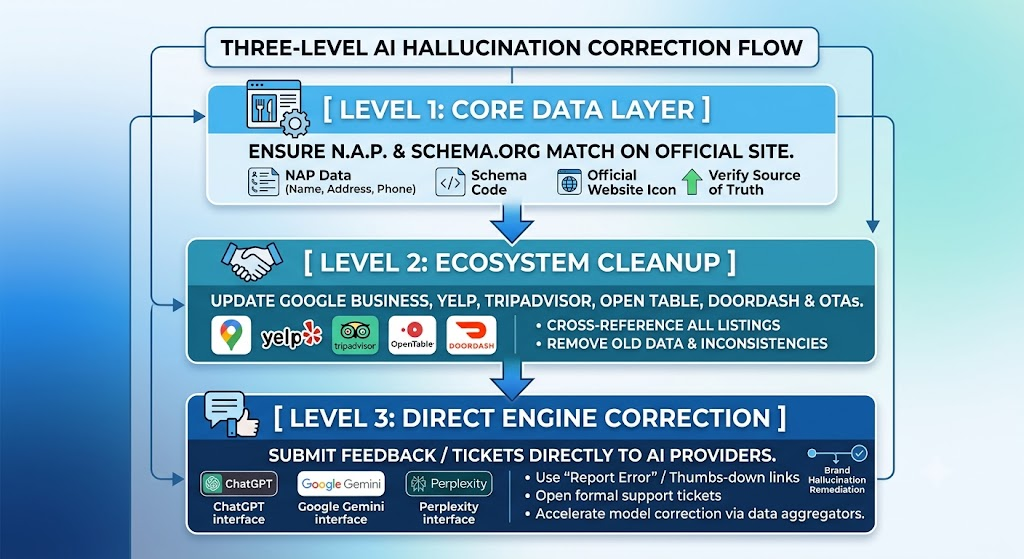
Level 1: Fix the master source
Your official website must serve as the absolute single source of truth. Remove PDF-only menus and replace them with plain HTML text accompanied by JSON-LD schema markup. Ensure your address, contact info and hours are prominent and identical on every page.
Level 2: Clean up the digital ecosystem
Consistency is critical. AI models cross-reference multiple web platforms to verify facts. Audit your Google Business Profile, Yelp, TripAdvisor, OpenTable and DoorDash pages. If your OpenTable listing says you close at 10:00 PM but your Yelp page says 10:30 PM, an AI model will guess — and it will often guess wrong.
Level 3: Submit feedback to the platforms
If an AI engine continues to output false information despite clean web data, use the platform’s native correction tools. Most major generative tools offer inline feedback mechanisms (such as the thumbs-down icon or a “Report Error” link). Furthermore, maintaining consistent business citations across major data aggregators accelerates model correction, as detailed in Insightland’s brand hallucination remediation strategy.
Take Control of Your Digital Front Door
In the generative search era, your digital front door is no longer just your website homepage or your Instagram grid. It is the paragraph of text an AI assistant synthesizes in response to a hungry guest’s prompt.
By regularly auditing AI search engines and maintaining a clean, structured digital presence, restaurant managers can ensure that when AI speaks about their restaurant, it tells the truth.