
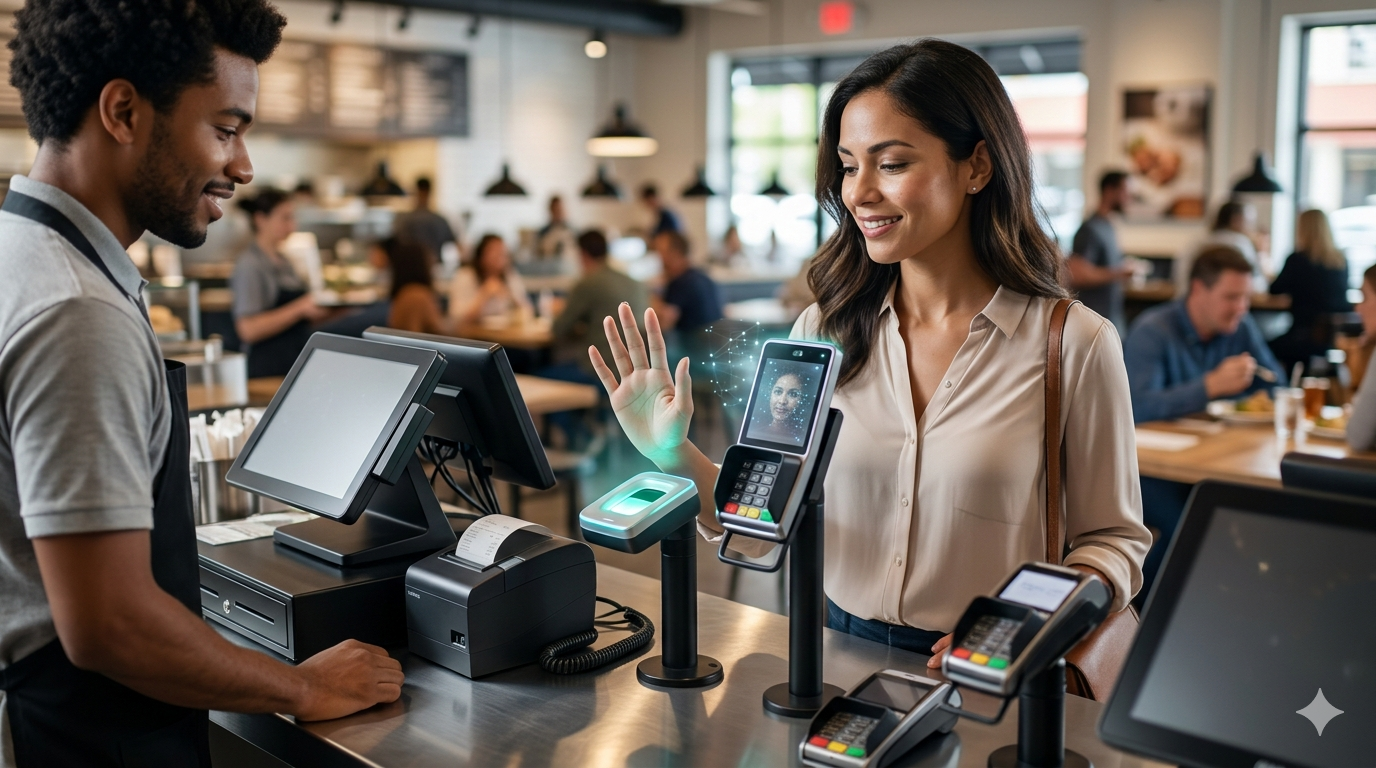
For years, the idea of walking into a restaurant, grabbing a coffee and paying with nothing but a smile or a wave of your hand felt like something out of a sci-fi movie. But as we move through 2026, that futuristic tech is becoming a daily reality for thousands of diners. From national giants like Whataburger to high-tech kiosks in stadiums, biometric payments are officially stepping out of the pilot phase and into the mainstream.
As a restaurant operator, you’ve likely mastered contactless cards and mobile wallets. But are you ready for a world where your guests don’t even need to reach for their phones? Let’s dive into the state of biometric payments in the U.S. and whether it’s time to add “Face” or “Palm” to your checkout line.
What Exactly is Biometric Payment?
At its core, biometric payment uses a person’s unique physical characteristics — typically their facial features or the vein patterns in their palm — to authorize a transaction.
Unlike a credit card that can be stolen or a phone that can run out of battery, biometrics are ‘always on.’ For a restaurant, this means the checkout process is decoupled from hardware. No fumbling for a wallet, no “card read error” on a terminal and no holding up the line while someone searches for the right app.
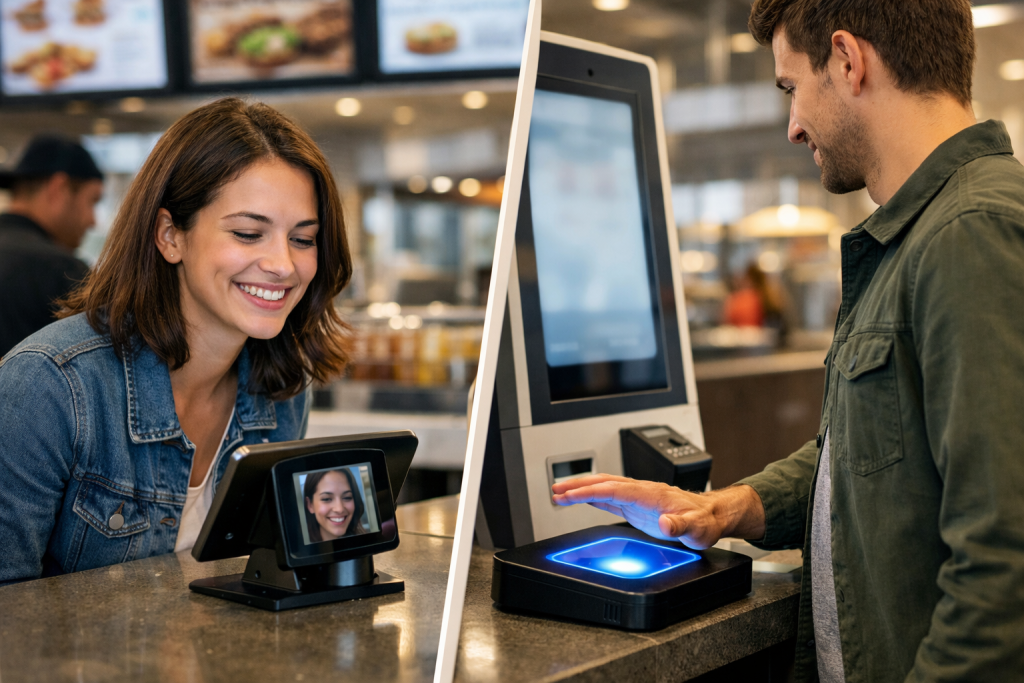
The Two Heavyweights: Face vs. Palm
- Face recognition: Often called “Pay by Smile,” this tech uses high-definition cameras to map facial geometry. It’s hands-free and lightning-fast.
- Palm recognition: Think of Amazon One. This tech scans the unique map of veins under the skin of your palm. It’s highly secure because, unlike a face, your internal vein patterns aren’t publicly visible.
Why 2026 is the Turning Point
In 2024 and 2025, we saw the foundations being laid. But several factors have converged to make 2026 the year biometrics actually move the needle for restaurant ROI.
1. The speed of fast-casual
In a high-volume QSR or fast-casual environment, seconds equal dollars. Traditional chip-and-pin or even tap-to-pay can take anywhere from 5 to 10 seconds per guest. Biometric checkouts are clocking in at under 2 seconds. According to recent reports on biometric payment efficiency, this doesn’t just cut lines, it significantly increases purchase value because the friction of spending is almost entirely removed.
2. The loyalty link
This is the secret sauce for operators. When a guest pays with their face, they aren’t just paying; they are identifying themselves. This means your loyalty program can be integrated directly into the payment. The system recognizes Mike, applies his points, offers him his usual discount and charges his card in one single, seamless step. No scanning a QR code or typing in a phone number required.
3. Major bank backing
A few years ago, this was the domain of niche startups. Today, the heavy hitters have entered the ring. J.P. Morgan Payments has partnered with PopID to bring “Pay by Smile” to merchants across the U.S., signaling to the industry that biometric infrastructure is now enterprise-grade and secure.
The Elephant in the Room: Is the Guest Ready?
It’s one thing for the tech to work; it’s another for the customer to trust it. Privacy is, and always will be, the biggest hurdle.
“Wait, are you storing my face?”
This is the most common question guests ask. As an operator, it’s vital to understand (and explain) that modern systems do not store raw images. Instead, they convert the scan into an encrypted, irreversible mathematical template or token. Even if a hacker stole the database, they would just see a string of random numbers, not a gallery of faces.
Should You Pilot Biometrics in Your Restaurant?
Before you rush out to buy new scanners, consider your concept. Biometrics aren’t a “one-size-fits-all” solution.
- The “Yes” list: If you run a high-volume coffee shop, a busy QSR or a stadium concession stand where speed is king, biometrics are a game-changer.
- The “Wait” list: If you run a fine-dining establishment where the “slow hospitality” of a seated meal is part of the charm, the speed of biometrics might feel a bit too clinical.
Implementation Checklist for Operators:
- Opt-in is mandatory: Never make biometrics the only way to pay. It should always be a “Fast Lane” option for those who choose it.
- Hardware integration: Ensure your POS can handle “tokenized” payments. Many modern systems are already “biometric-ready” via simple API integrations.
- Staff training: Your team needs to be able to explain the security features. If they can’t confidently say, “Your data is encrypted and we don’t store your photo,” the guests won’t trust the system.
Conclusion: The Future is “Wallet-Less”
The U.S. might not be 100% biometric today, but the momentum is undeniable. We are moving toward an “Ambient Commerce” world — a world where the transaction happens in the background, allowing the restaurant to focus on what matters most: the food and the guest.
By 2030, we’ll likely look back at credit cards the same way we look at paper checks today. The question for operators isn’t if biometrics will arrive, but when you want to lead the charge.