
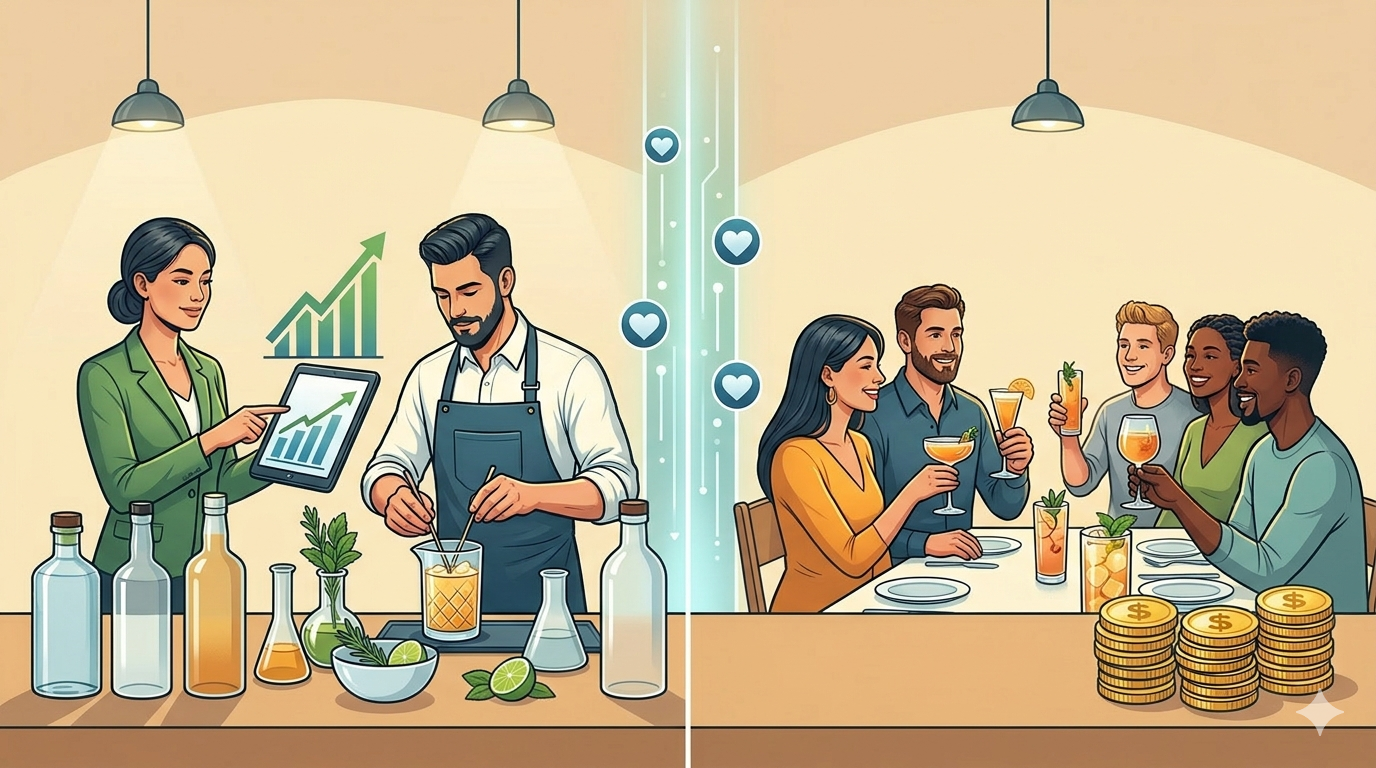
Let’s be honest: for decades, the “non-drinker” at the table was the restaurant’s smallest fan. They were the ones sticking to tap water or perhaps a dusty bottle of club soda with a lonely lime wedge. From a business perspective, they represented a “lost” seat – someone taking up space without contributing to those juicy high-margin beverage sales that keep the lights on.
But fast forward to 2026 and the script has been completely flipped. Whether it’s Gen Z leading the charge with a more mindful approach to consumption or the “Sober Curious” movement going mainstream among Millennials and Boomers, people are drinking less, but they aren’t looking for less of an experience.
If you’re still treating your non-alcoholic (NA) section as an afterthought, you’re leaving serious money on the table. It’s time to stop thinking about what’s missing from the glass and start thinking about the profit you can pour into it.
The Myth of the “Cheap” Non-Drinker
There is a lingering fear among operators that if people stop ordering $15 cocktails, the bottom line will crumble. However, the “Sober Curious” guest isn’t looking for a cheap night out; they are looking for a sophisticated drink that happens to be 0.0% ABV.
The beauty of a well-engineered NA program is the margin. While a premium gin or bourbon carries a heavy cost of goods sold (COGS), a house-made botanical syrup, a splash of high-quality verjus and a garnish of fresh herbs can often be produced for a fraction of the cost. When you price these “Zero-Proof” masterpieces at $10 or $12, your percentage margin often eclipses that of your standard bar menu.
According to Datassential, the number of people interested in low or non-alcoholic beverages is steadily on the rise. From non-alcoholic mind boosting beverages and tea-based mocktails, to hop tea and functional beverages, there’s a clear increase in drinks that are devoid of alcohol.
Engineering the Zero-Proof Menu: Beyond the “Mocktail”
First things first: can we retire the word “mocktail”? It sounds like a “mockery” and your guests can tell. High-margin programs use terms like “Zero-Proof,” “Spirit-Free” or “Placebos”. To engineer a menu that commands a premium price, you need to focus on three elements: complexity, texture and ritual.
- Complexity: Use ingredients that mimic the “bite” of alcohol. Think ginger, black pepper, chili or bitter elements like gentian root and grapefruit pith.
- Texture: Alcohol has a specific mouthfeel. You can replicate this using seed-based milks, aquafaba for foam or tannins from over-steeped teas.
- Ritual: This is the most important part. A $12 NA drink should come in a chilled coupe, a heavy rocks glass or a beautiful flute. It should be garnished with the same precision as your best Old Fashioned. People pay for the feeling of having a drink, not just the liquid.
Check out this guide on modern menu engineering to see how restaurants are strategically placing these high-margin NA options in the ‘sweet spots’ of their menus to drive higher check averages.
The “Sober Curious” Tech Stack: Inventory and Innovation
Managing a high-end NA program requires a bit more finesse than just ordering cases of Coke. You’re dealing with dealcoholized wines (which have a shorter shelf life once opened) and artisanal shrubs.
This is where your technology comes into play. Your inventory management system should be tracking these “functional” ingredients with the same rigor as your top-shelf scotch. Because many NA spirits are made via distillation and then “dealcoholized,” they can actually be more expensive to produce than standard spirits. You need real-time data to ensure your pricing reflects the cost of these premium inputs.Furthermore, using your customer data platform (CDP) can help you identify who your NA fans are. If your data shows a guest consistently orders the “Hibiscus & Pink Peppercorn Fizz,” your automated marketing can target them when you launch a new seasonal NA pairing dinner. Predictive analytics are helping operators anticipate the rise of health-focused dining trends, allowing them to pivot their inventory before the demand peaks.
Staff Training: The Art of the Suggestive Sell
Your servers are your best advocates. If a guest says, “I’m not drinking tonight,” a poorly trained server might say, “Oh, okay. Just water then?”
That is a $10 mistake. Instead, train your team to pivot: “We actually have an incredible Zero-Proof program. Our ‘Midnight Forest’ uses a dealcoholized red wine reduction with cedar smoke. It’s actually our most popular drink right now, regardless of the alcohol.”
Make sure your staff tastes the NA menu during line-up. They need to be able to describe the flavor profile (is it “bright and herbaceous” or “moody and spiced”?) just as they would a Napa Cab. When the staff treats the NA menu with respect, the guests will too.
Marketing the Mindful Experience
Don’t hide your NA drinks on the back page next to the hot tea. Feature them. If you have a cocktail of the month, have a “Placebo” of the month right next to it.
On social media, showcase your Zero-Proof drinks with the same high-production photography you use for your food. In 2026, the “aesthetic” of the drink is half the sale. A beautiful, garnish-heavy NA drink is highly “Instagrammable,” providing you with free marketing while signaling to the sober-curious community that they are welcome and valued in your space.
Final Thoughts: The Inclusive Bottom Line
At the end of the day, engineering a high-margin NA program is about hospitality. It’s about making sure that every person at the table, regardless of what’s in their glass, feels like they are part of the celebration.
By focusing on premium ingredients, sophisticated presentation and strategic pricing, you turn a “dead” seat into a profit center. You’re not just selling juice; you’re selling a sophisticated, inclusive experience that keeps people coming back, glass after (0.0%) glass.