
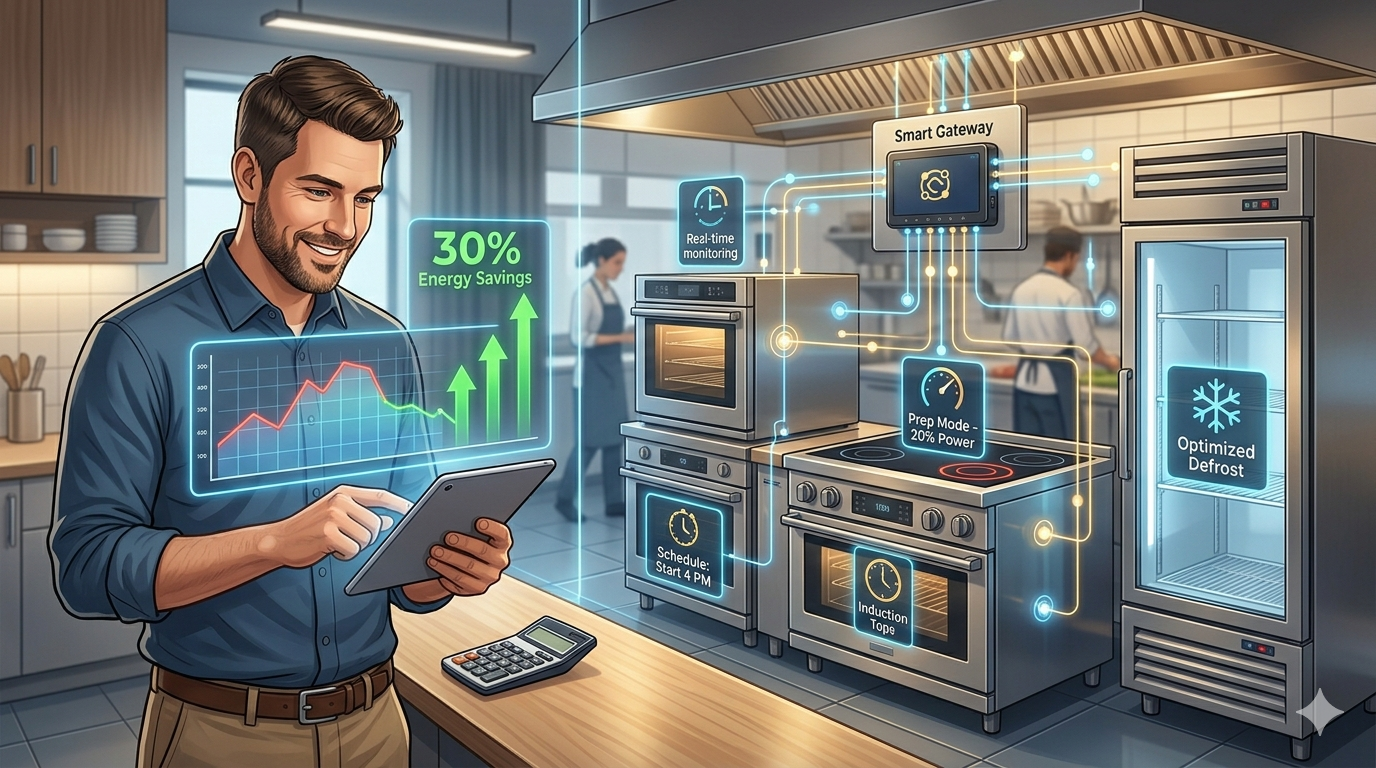
If you walk into a commercial kitchen at 4:00 PM, you’ll likely witness a costly ritual: the line prep team walking down the line, flicking on the flat-tops, firing up the salamanders and cranking the ovens. For the next seven hours, that equipment will radiate intense heat into an empty room, sucking up thousands of kilowatt-hours long before the first guest orders an appetizer.
Historically, restaurants have written off these massive utility spikes as the non-negotiable cost of doing business. Because commercial kitchens consume five to seven times more energy per square foot than standard commercial buildings, keeping the lights, hoods and cooklines running at full throttle felt like the only way to avoid service bottlenecks.
But a fundamental shift in kitchen operations has quietly arrived. By moving away from manual, unmetered environments and embracing a unified, IoT-connected ecosystem, operators are taking complete control over their utilities. Smart kitchens are no longer just about remote monitoring; they represent an automated approach to energy management that slashes bills by up to 30% while streamlining back-of-house operations.
The Idle Cost Epidemic: Moving Beyond the “Always On” Mindset
The primary reason commercial kitchens bleed energy isn’t the cooking itself; it’s the idle time. Traditional appliances operate on a binary framework: they are either completely on or completely off. Because chefs require immediate recovery times during a rush, equipment stays fully cranked through late-afternoon lulls and post-dinner drops.
An IoT-connected kitchen addresses this inefficiency by introducing localized intelligence. When appliances are linked via a unified cloud-based system, they stop working in isolation.
Smart kitchen platforms leverage connected systems to dynamically bridge the gaps between refrigeration, HVAC and cooking lines. If the platform detects a historical lull in transactions between 3:00 PM and 4:30 PM, it can automatically transition idle fryers or combi-ovens into low-power, rapid-recovery “sleep modes” without requiring a single manual adjustment from your line cooks.
Intelligent Ventilation: The High-Margin Win of Demand-Controlled Hoods
Your exhaust hoods are arguably the biggest energy hogs in the entire building. Traditional ventilation systems run at 100% capacity from morning prep until the closing crew locks up, continuously sucking conditioned air out of the building and forcing your HVAC system to work overtime to stabilize the dining room temperature.
Modern Smart Kitchens disrupt this dynamic by pairing IoT sensors directly with variable-speed fan drives. Optical sensors and thermal probes mounted inside the hood canopy continuously read the exact output of the cookline below:
- The prep window: If the team is merely slicing tomatoes, the hoods run at a whisper-quiet 20% capacity.
- The rush: The moment smoke, steam or high heat waves are detected from a searing station, the system instantly ramps up fan speeds to clear the air.
- The lull: As the cookline cools down, the fans drop back down to a minimal, energy-saving baseline.
By matching ventilation speed to actual cooking activity rather than running at maximum capacity, operators can cut hood electricity consumption by up to 50%, generating immediate relief on both your utility bill and your overall HVAC wear and tear.
Refrigeration Optimization: Defeating Compressor Cycle Fatigue
Refrigeration is the only asset in your building that can never be turned off. Walk-ins and low-boys must maintain strict food safety parameters 24/7/365, making them incredibly vulnerable to hidden energy drains like failing door gaskets, frosted coils and erratic compressor cycles.
According to a 2026 commercial kitchen innovation report by Your Kitchen Center, the industry is rapidly transitioning toward eco-friendly R-290 cooling units deeply integrated with real-time IoT diagnostic software.
Instead of waiting for a walk-in freezer to fail and ruin thousands of dollars in proteins, smart refrigeration tracks continuous performance metrics. If a compressor starts cycling twice as often as it should to maintain a safe temperature — a surefire sign of a leaky seal or a clogged condenser — the system instantly pings management with a preventative maintenance alert. This targeted approach allows you to repair a minor component before it degrades your energy efficiency or triggers an emergency, high-cost repair during a busy weekend service.
The Financial Reality of Connected Tech
Investing in an IoT infrastructure isn’t about chasing a high-tech trend; it’s a direct play to protect your operating margins from volatile utility markets. When you connect your infrastructure, you stop paying for energy you aren’t actively using to cook food.
The transition to a smart kitchen doesn’t require tearing out your entire line overnight, either. Many modern operators are successfully executing a modular strategy, starting with retrofitted IoT sensors on existing walk-ins and demand-controlled hoods, then choosing fully connected smart appliances as older equipment ages out.
Take a walk through your kitchen after your next closing shift. Look at the dials that were left turned up, the hoods running in an empty space and the low-boys working overtime. The data to cut those bills is already living inside your kitchen; you just need to plug it in.