
Picture this: it is 6:30 PM on a Friday night. The ticket machine is churning out orders like a runaway receipt printer, pots are clanging, oil is crackling and someone just yelled “Order fire!” across a cramped line.
Now imagine you are 19 years old, it is your very first day on the job and your entire training consisted of watching a fifteen-minute video on an old tablet in the breakroom and shadowing a frantic prep cook for an hour.
Your hands tremble. You drop a five-dollar portion of prime rib-eye onto the floor. You accidentally grab the wrong sauce for a table with a severe nut allergy. By 9:00 PM, you are thoroughly exhausted, thoroughly overwhelmed and secretly calculating how awkward it would be to ghost the manager and never come back.
Sound familiar? For decades, that trial-by-fire scenario was practically a rite of passage in commercial kitchens. We threw new hires straight into the heat, crossed our fingers and wondered why line cook turnover was hovering around 75%.
Fortunately, there’s a much better way of taking over back-of-house operations: immersive VR onboarding. Instead of sinking or swimming on night one, the next generation of line cooks, prep crew and kitchen managers are stepping into virtual kitchens, strapping on a headset and mastering the line long before they ever touch a live flame.
A Day in the Virtual Kitchen: Leo’s First Shift
To see how this works in the real world, let’s talk about Leo.
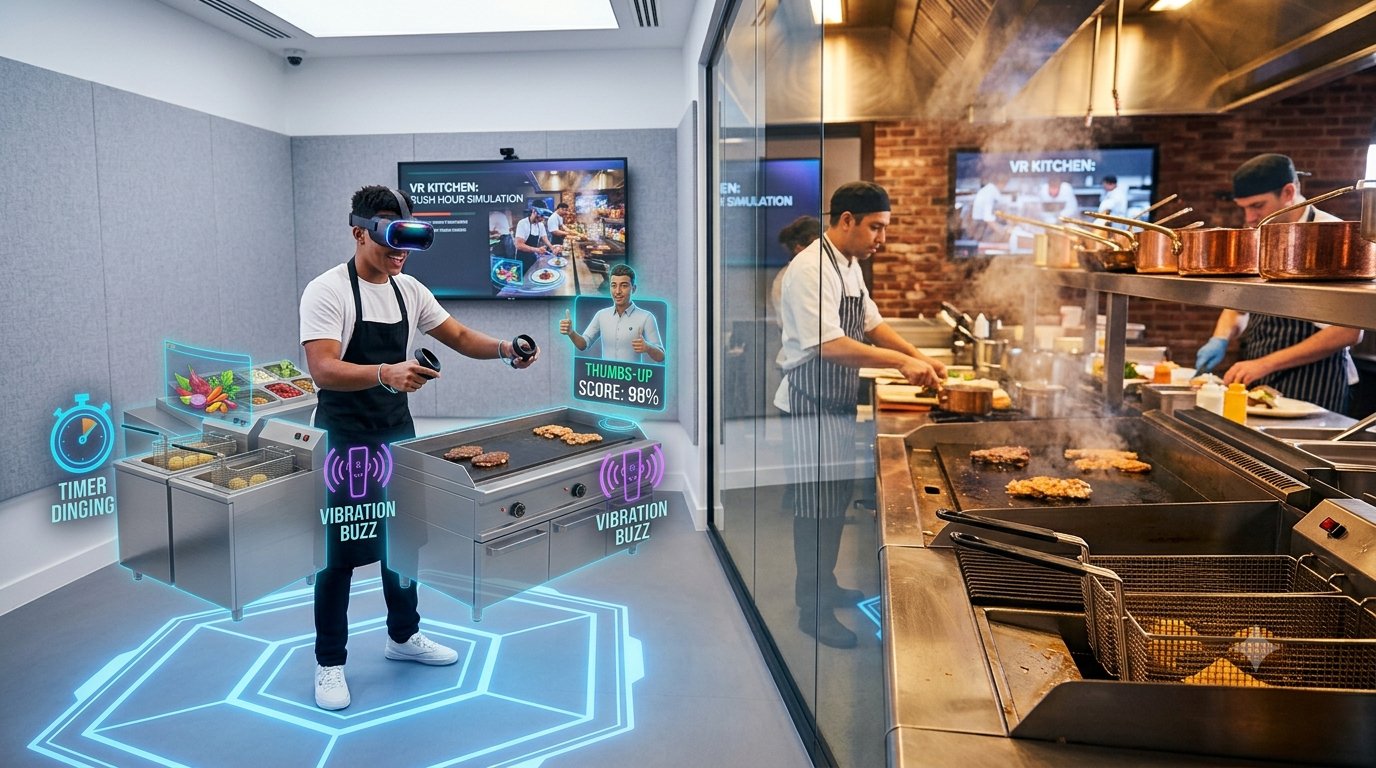
Leo just got hired as a line cook at a high-volume casual dining spot. On his first morning, his manager didn’t toss him an apron and tell him to keep up with the lunch rush. Instead, Leo sat down in a quiet office, adjusted a comfortable VR headset and picked up two hand controllers.
Immediately, he was standing inside a pixel-perfect 3D replica of the restaurant’s actual kitchen. He could look around and see the exact layout — the flat-top grill on his left, the fryer bank on his right, the pass straight ahead and the ticket display right at eye level.
A virtual coach guided him through his first lesson: preparing the signature bacon cheddar burger.
In the simulation, Leo picked up a virtual spatula, dropped a virtual patty onto a sizzling grill surface and flipped it when the timer dinged. When he reached for the wrong cheese, the system gave him a gentle haptic buzz in his controller and prompted him with the correct assembly order. He repeated the process five times until the motion memory settled in.
Then, the simulator dialed up the pressure. It triggered a “rush hour mode” — tickets started stacking up, order chimes began beeping and a virtual server popped up to ask for a rush on table four.
When Leo accidentally undercooked a patty in the virtual simulation, nobody got sick, no food went into the trash can and no head chef screamed across the line. He simply reset the module and tried again until he nailed the timing.
By the time Leo stepped onto the real line for his first actual dinner service three days later, he didn’t feel like a nervous rookie. He felt like he had already worked a hundred shifts.
Why VR Training Actually Works (Without the Tech Jargon)
It’s easy to dismiss virtual reality as a gimmick meant for video games, but major brands and independent restaurant groups are discovering that immersive learning solves very real, very expensive operational problems. Immersive tech gives workers a multi-sensory way to build muscle memory and retain knowledge much faster than traditional handbooks ever could.
Here is why this approach is making such a big splash in back-of-house training:
1. Zero waste, infinite practice
Every time a brand-new cook burns a piece of salmon or over-sears a steak during traditional training, that money comes straight out of your food margin. With interactive modules, trainees can practice slicing, searing, plating and portion control hundreds of times without wasting a single ounce of real food.
2. Safety without the emergency room
Kitchens are full of hot grease, razor-sharp knives and heavy equipment. Teaching a beginner how to clean a commercial slicer or handle a grease flare-up in a real kitchen carries genuine risk. In VR, new hires can walk through emergency protocols and high-risk sanitation procedures until safety habits become second nature, all in an environment where it’s impossible to get hurt.
3. Consistency across every shift
If you run multiple locations, you know how hard it is to maintain standardized prep routines. One head chef might teach a recipe one way, while a lead cook at another location skips three crucial steps. VR provides a single, standardized gold standard for every single employee, regardless of who happens to be managing the floor that day.
Building a Connected Kitchen Culture
VR onboarding doesn’t exist in a vacuum. It is part of a broader evolution in how modern kitchens operate. Once new team members are comfortable with their station mechanics in virtual space, they transition far more smoothly into high-tech, connected kitchen environments.
Today’s line cooks aren’t just flipping burgers; they are operating smart ovens, managing digital display systems and monitoring automated prep tools. When you pair tech-savvy onboarding with modern kitchen infrastructure — like the setups detailed in this guide on Smart Kitchens & IoT — you create an environment where technology supports your staff rather than overwhelming them.
The Big Takeaway: Tech That Makes Us More Human
There is a common fear whenever new technology enters the restaurant space: Will this make our kitchens feel cold, robotic and soulless? In reality, the exact opposite happens.
VR onboarding isn’t meant to replace human mentorship, camaraderie or the joy of cooking together. It simply takes away the scary, sink-or-swim anxiety that makes starting a kitchen job so miserable for new hires. By giving your crew a safe space to make mistakes, build confidence and master their craft before the Friday night rush hits, you aren’t just saving money on dropped food and turnover. You are building a team that actually feels supported, capable and ready to cook great food together. And really, isn’t that what hospitality is all about?