
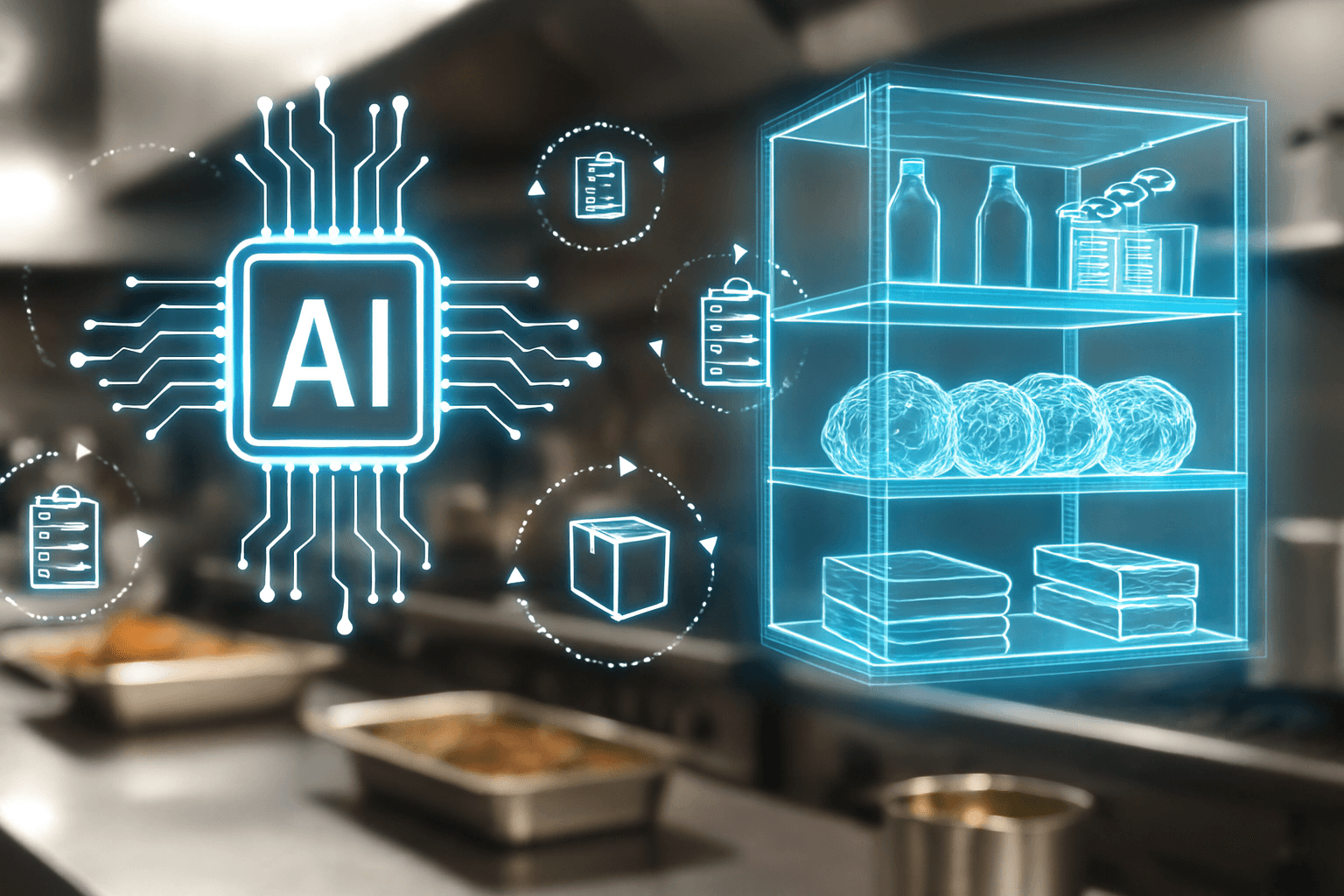
The margin for error in the restaurant industry is razor-thin. For decades, inventory management – the bedrock of profitability – has been a reactive, often manual, process: count the stock, subtract what was sold and place an order. Digital tools streamlined the counting, moving us from clipboards to tablets, but fundamentally, they remained simple digital ledgers.
That era is over.
We are now entering the age of predictive inventory management, a transformative shift powered by artificial intelligence (AI) and machine learning (ML). This new approach moves far beyond basic stock tracking; it turns your inventory system from a rearview mirror into a high-powered, multi-dimensional crystal ball, offering unprecedented accuracy in demand forecasting. The goal is simple yet profound: have exactly what you need, when you need it and nothing more. The result? Optimized ordering, a significant reduction in food waste and dramatically lower food costs.
The Predictive Leap: How AI Models Master Demand Forecasting
Traditional inventory systems use one primary data point to forecast: historical sales. If you sold 100 steaks last Tuesday, the system assumes you’ll sell about 100 next Tuesday. This is a linear, two-dimensional view that ignores the real-world complexity of demand.
AI and ML algorithms, on the other hand, are designed to find patterns and correlations across a massive, disparate dataset. They use your historical sales as a baseline but enrich the analysis by layering in powerful external variables, creating a robust, multi-factorial forecast.
The Data Symphony: Beyond the Register
A truly predictive model analyzes several key data streams:
- Historical sales & menu mix: The foundation, broken down by hour, day of the week, server performance and prep time, understanding not just what sold but when and how quickly.
- Weather patterns: A proven predictor. ML models learn, for example, that a sudden heatwave drives a 30% surge in salad and iced drink sales and a 15% drop in heavy pasta dishes.
- Local event data (holidays, sports, concerts): Is there a major game at the arena nearby? Is it a public holiday weekend? These events significantly alter traffic and demand, which AI can quantify and incorporate into the forecast.
- Social media sentiment & trends: Monitoring local buzz or national food trends (e.g., a viral TikTok recipe) can indicate a sudden surge in demand for specific ingredients, allowing for pre-emptive ordering.
- Supplier lead times & quality data: The system learns how long it takes a specific vendor to deliver and, crucially, tracks the historical quality of their deliveries (e.g., did 5% of the last produce shipment spoil before use?).
By cross-referencing these inputs, AI can generate a forecast that is hyper-accurate, calculating the precise amount of, say, diced tomatoes or fresh salmon required for the next three days, with a confidence score attached. This moves decision-making from gut feeling to data-driven precision.
Key Features of Next-Generation Inventory Software
As you evaluate new solutions, look beyond standard features like barcode scanning and supplier catalog integration. A truly next-generation platform must possess these AI-driven capabilities:
- Dynamic par-level adjustments: Instead of setting a static minimum (par) level for an ingredient, the software should automatically adjust this level based on the real-time forecast. On a forecasted slow Tuesday, the par level for chicken breast might drop to 50lbs; on a sunny Friday before a long weekend, it might jump to 120lbs.
- Optimal order suggestion & scheduling: The system shouldn’t just tell you what to order, but when and from whom, factoring in vendor pricing, delivery frequency and the freshness-decay curve of the product.
- Wastage analysis with root cause: Advanced AI tracks spoilage (waste) and attempts to determine the root cause (e.g., over-ordering vs. poor storage vs. prep-error) to suggest operational and training improvements.
- Recipe costing & yield optimization: Real-time integration with menu prices to calculate exact plate cost and suggest minor recipe tweaks or portion adjustments to maintain target food cost percentages without sacrificing quality.
The best systems make these complex calculations invisible, presenting the chef or manager with a simple, approved purchase order ready to submit, reducing the order process from hours to minutes.
Roadmap for Seamless Integration
Implementing a predictive system requires a thoughtful, phased approach to ensure a smooth transition and maximize adoption.
Phase 1: Data audit and system selection (Months 1-2)
The core principle of AI is “garbage in, garbage out.” Start by cleaning your data.
- Standardize inventory naming: Ensure every item is consistently named and coded across all internal systems.
- Audit historical sales data: Verify the accuracy and completeness of at least 12-18 months of POS data.
- Select a partner: Choose inventory software with open APIs (Application Programming Interfaces) designed for bi-directional communication.
Phase 2: POS system integration (Months 2-4)
This is where the ‘predictive’ muscle is built.
- Connect external data: Link the software to APIs, local event calendars and any relevant social media monitoring tools.
- Calibration period: Run the AI-generated forecasts alongside your traditional ordering method. Compare the results, track spoilage and fine-tune the model parameters based on early performance metrics. This dual-track approach minimizes risk during the learning period.
The Return on Investment: Beyond Cost Savings
While the immediate financial benefits – a potential 5-10% reduction in food cost and a significant decrease in food waste – are compelling, the value of predictive AI extends further.
- Labor optimization: Managers spend less time counting and calculating, freeing them up to focus on customer experience and team training.
- Consistent quality: By ensuring the correct ingredients are always in stock, service is never compromised by “86’d” menu items or rushed, subpar substitutions.
- Sustainability: Reduced spoilage is a massive win for environmental sustainability, aligning your business with ethical consumer values.
Predictive inventory management isn’t a luxury; it’s the new baseline for operational excellence. It allows restaurateurs to finally rise above the tyranny of the daily count and focus on what truly matters: delivering an exceptional dining experience.