
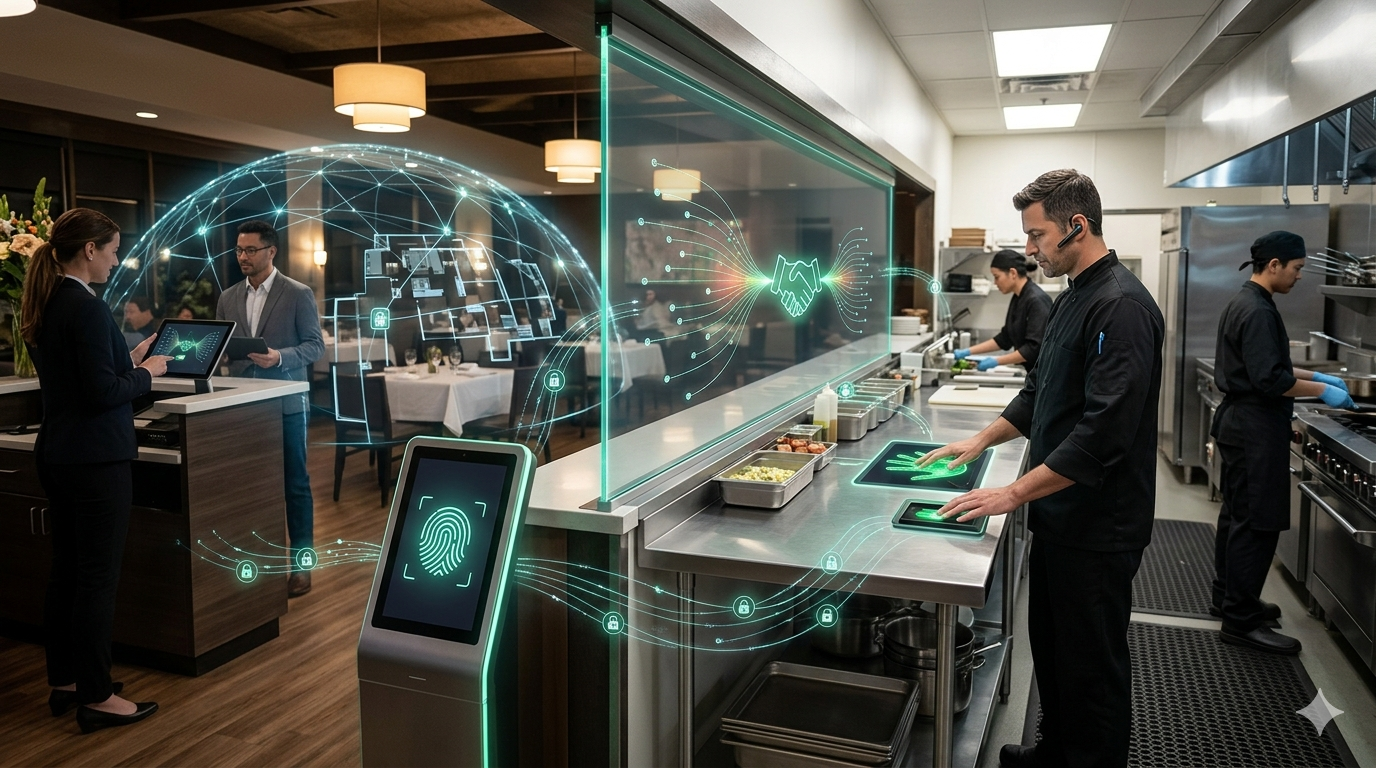
For decades, the four-digit PIN has been the skeletal key of the restaurant world. It’s how servers clock in, how managers authorize voids and how bartenders access the “high-pour” list. But as we move through 2026, that four-digit code has become a liability that independent operators can no longer afford to ignore.
In a landscape where your guest data — names, emails and spending habits — is stored in integrated Customer Data Platforms (CDPs), a stolen manager PIN isn’t just a nuisance. It’s a backdoor for cybercriminals to harvest your most valuable digital assets. The solution that is shifting from the “edge” of tech into the mainstream is Biometric Proof of Presence. If you want to secure your margins and your reputation, it’s time to move beyond the PIN and into a world where identity is tied to the person, not a number scribbled on a sticky note.
The Death of the PIN and the Rise of ‘Labor Leakage’
The traditional PIN system suffers from two fatal flaws: it is easily shared and easily stolen. In the industry, we’ve long turned a blind eye to “buddy punching” — the practice of one employee clocking in another who is running ten minutes late. While it might seem like a small cultural quirk, the cumulative effect of this “labor leakage” can account for 2% to 5% of total payroll costs.
But by 2026, the stakes have evolved from simple time-theft to high-stakes data-theft. Credentials (passwords and PINs) remain the top entry point for hackers. In a restaurant setting, once a malicious actor gains a manager’s PIN, they have the keys to the castle: the ability to export guest lists, issue massive fraudulent refunds or even shut down the POS system entirely during a Saturday night rush.
What is Biometric ‘Proof of Presence’?
Biometric “Proof of Presence” (PoP) uses physical identifiers — most commonly fingerprints, facial recognition or iris scans — to verify that a specific human being is physically standing at a station before an action is authorized.
In a 2026 workflow, it looks like this:
- The authorization: A server needs to void a $120 bottle of wine. Instead of shouting, “Hey, what’s your code?” to a manager across the room, the manager walks to the terminal and taps a biometric sensor.
- The log: The system doesn’t just record that “Manager PIN 101” authorized the void; it records that Marcus authorized it at 8:12 PM.
This creates an immutable audit trail. When your POS data is tied to a biological signature, the “I didn’t do that” excuse vanishes. This level of accountability is strong enough to withstand scrutiny in legal and compliance contexts.
Scenario: Preventing the Saturday Night ‘Ghost Refund’
Consider a busy independent bistro. A disgruntled former employee knows the General Manager PIN is 1234, because it’s been the same for three years.
- The vulnerability: Using a remote access tool or even just walking in during a frantic shift change, the actor logs into the POS and issues twenty $100 refunds to various untraceable gift cards.
- The biometric defense: With Proof of Presence enabled, the system requires a biometric “handshake” for any refund over $50. Because the former employee isn’t physically there to provide a fingerprint or facial scan, the transaction is blocked instantly. The ‘Ghost Refund’ is dead on arrival.
Workforce Psychology: Friction vs. Fairness
One of the primary pushbacks against biometrics is the ‘Big Brother’ concern. Staff may feel that iris scans or fingerprints are an overreach. However, the shift in 2026 is toward ‘Frictionless Fairness’. When you frame biometrics as a tool for staff protection, the narrative changes. Biometrics ensure that a server’s tips are never ‘adjusted’ by someone else using their code. It ensures that the hardworking team members aren’t subsidizing the ‘buddy punchers’.
Furthermore, modern biometric hardware, like the sensors found on the latest handheld tablets, is faster than typing a PIN. A sub-second fingerprint tap is more efficient than fat-fingering a code on a greasy screen. It’s not about surveillance; it’s about identity integrity.
The OBBBA Connection: Funding the Upgrade
The “One Big Beautiful Bill Act” (OBBBA) of 2025 has provided a unique window for this transition. Under the Act’s updated provisions for R&D and capital equipment, the hardware and software integration costs for biometric security systems are largely eligible for immediate expensing or significant tax credits.
Operators are realizing that 2026 is the year to swap out their aging, PIN-reliant legacy systems for ‘Smart POS’ hardware. By leveraging the OBBBA, the net cost of upgrading to biometric-enabled tablets is often lower than the potential cost of a single data breach fine.
The Bottom Line: Secure the Human
The independent restaurant of 2026 is a data-driven enterprise. You are handling more guest information and more digital transactions than ever before. Continuing to protect that data with a four-digit PIN is like putting a padlock on a bank vault.
Biometric Proof of Presence isn’t just about stopping time theft; it’s about securing the human element of your operation. It tells your guests that you take their data seriously, it tells your staff that you value accountability, and it tells cybercriminals that your restaurant is no longer an easy target.
It’s time to stop asking your managers for their numbers and start asking for their presence.