
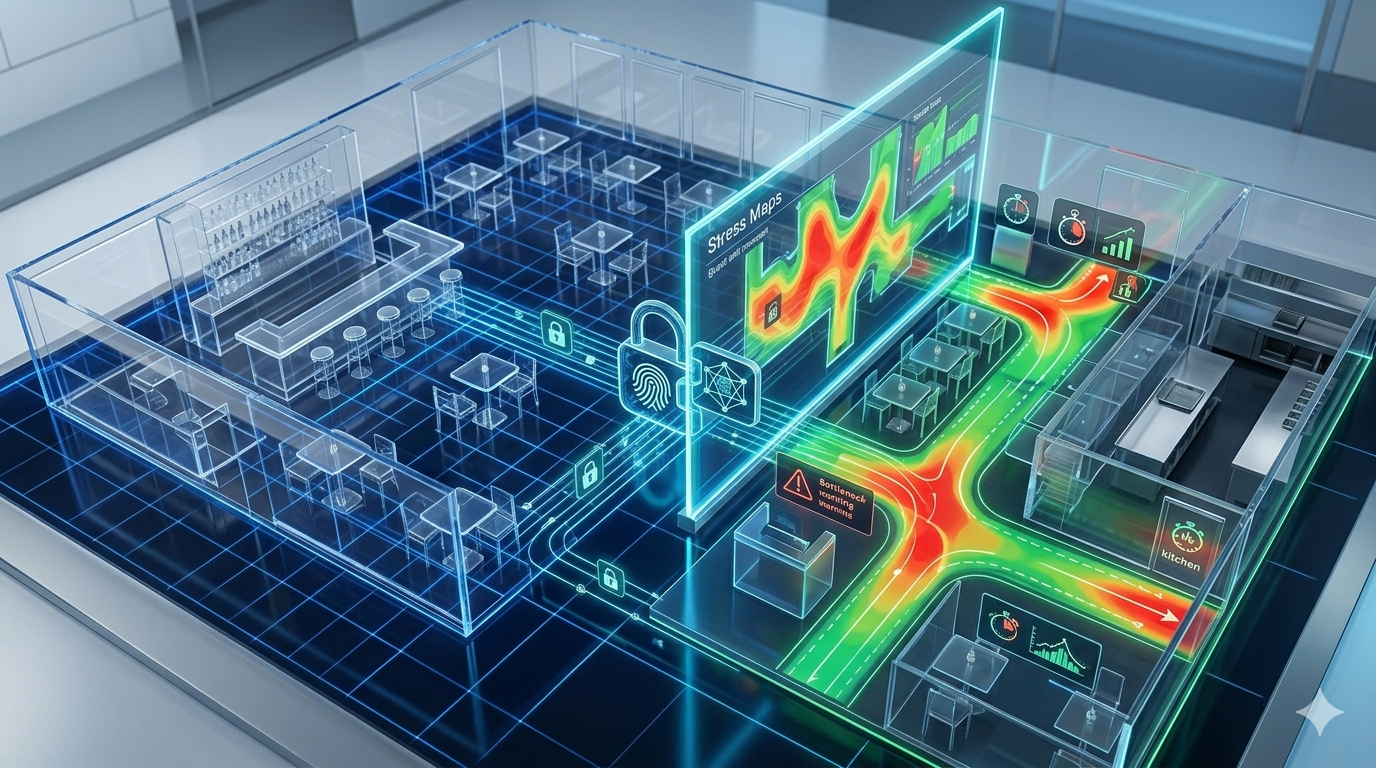
Every seasoned operator has a “ghost” in their floor plan — that one corner table no one wants to sit at or the kitchen pass-through that turns into a four-person pileup every Saturday at 8:00 PM. Usually, you don’t find these ghosts until the concrete is poured and the opening night chaos begins. But by 2026, the most successful builds aren’t starting with a sledgehammer; they’re starting with a “Digital Twin”.
We’ve moved past the era of static blueprints and gut feelings. Today, smart operators are building their entire restaurant twice — once in a high-fidelity virtual simulation and once in the real world. This isn’t just a 3D walkthrough for investors; it’s a living, breathing stress-test that catches operational heartbreaks before they cost you a dime.
What exactly is a “Digital Twin”?
Think of a digital twin as a video game version of your specific restaurant, powered by real-world physics and your actual sales data. Unlike a flat CAD drawing, a digital twin understands volume and velocity. It knows how long it takes a server to walk from the POS to the service bar and it can predict exactly where a delivery driver will stand while waiting for a bag.
As noted by IBM’s latest guide on digital twin technology, these virtual models are used to run “what-if” scenarios, projecting how a complex system — like a 60-seat bistro — might behave under extreme stress. Instead of guessing if your new open-kitchen concept will overheat the dining room, you can simulate the BTU output of your grill alongside the August humidity and see the result on a screen.
Hunting for the “Collision Points”
The most expensive square footage in your building is the space where people run into each other. When your food runner’s path crosses the host’s path to the front door, you aren’t just losing seconds; you’re losing the vibe of a professional service.
By using a digital twin to stress-test your floor plan, you can identify these bottlenecks before they become permanent.
The delivery reality check: Many 2026 operators are finding that their 2020-era floor plans can’t handle the surge in third-party pickups.
- The old fix: You shove a wire rack near the host stand and hope for the best.
- The digital twin fix: You simulate 40 pickups per hour. The model shows your “Entry-Exit” zone turning bright red — a total logjam. In the virtual model, you can test moving the pickup window to a side door or shrinking the bar by 14 inches to create a “Quick-Flow” lane. You see the solution work on screen before you hire a contractor.
Kitchen Ergonomics: Shaving Seconds Off the Line
Kitchen labor is likely your highest “per-minute” cost. Every extra pivot a line cook has to make to reach a reach-in or a garnish station is “empty labor.” Over a year, those extra steps equal thousands of dollars in wasted wages.
Digital twin modeling allows for a “Heat Map” analysis of your BOH (Back of House) staff. You can virtually track your sauté cook’s movements during a simulated rush. If the model shows them crossing the kitchen 300 times just to grab butter or stock, the layout is broken. In the 2026 landscape, where industry analysts emphasize deep operational integration, the difference between a 12-minute and a 15-minute ticket time often comes down to the three feet between the grill and the prep table.
The Energy Bill: Stress-Testing Your HVAC
It’s not just about the people; it’s about the air. One of the biggest hidden costs in a new build is an HVAC system that can’t keep up with the kitchen’s heat. A digital twin can simulate your thermal load based on equipment specs and dining room occupancy.
You can “stress-test” your energy consumption by running a simulation of a 95-degree day with a full house. Will your guests at table 14 be sweating? The model will tell you. By testing window tints, ceiling heights, or hood vent placements in a virtual space, you can often cut your projected utility overhead by 15% before you even sign the lease.
From Global Chains to the Corner Bistro
There is a lingering myth that digital twin tech is only for the McDonald’s of the world. While PepsiCo and NVIDIA are using massive industrial twins to model entire production lines, the tech has trickled down to the independent level.
Tools like Matterport and LIDAR-enabled smartphones allow you to create a dimensionally accurate 3D model of your shell in an afternoon. From there, you can plug that data into simulation software to test everything from “Instagrammable” lighting angles to the speed of your dish pit.
Don’t Build It Until You’ve Won
A digital twin isn’t about being “high-tech” for the sake of it. It’s about risk mitigation. It’s the ultimate “measure twice, cut once” tool for an industry where the cost of a mistake can be a closed sign on the front door.
By stress-testing your floor plan in the virtual world, you ensure that on opening night, your staff isn’t fighting the building, but rather they’re focusing on the hospitality. In the tight-margin environment of 2026, the smartest restaurants are the ones that have already been “run” thousands of times before the first guest ever walks through the door.