
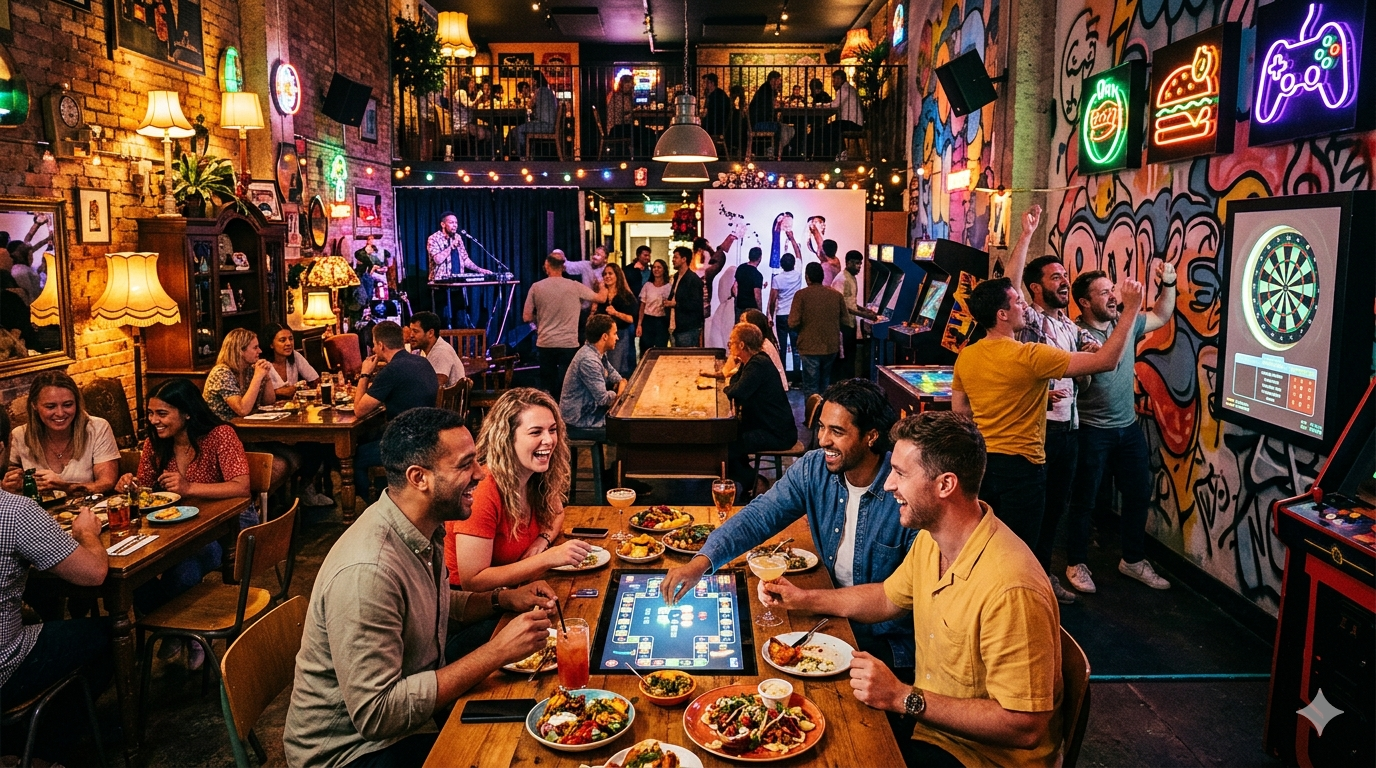
Let’s be honest for a second: the days of just serving a decent medium-rare steak and calling it a night are retreating faster than a customer without a reservation on a rainy Friday. We have officially crossed the threshold into the era of Experiential Dining 2.0. It is no longer enough for the food to taste good; the environment has to feel like a high-five for the soul and a masterpiece for the social feed. Modern diners, especially those elusive Gen Z and Millennial cohorts who hold the keys to the kingdom of discretionary spending, are increasingly trading their precious couch-time for something the industry calls “competitive socializing.” They want to eat, sure, but they also want to throw a hatchet, solve a noir murder mystery or dominate a high-tech round of digital darts while they do it. If your restaurant feels like a library where people happen to chew, you might be missing the heartbeat of the modern market.
From Static Seating to Hybrid Hubs
If you are currently managing a space and wondering why your foot traffic feels a bit “pre-pandemic” or static, it is time to look at your square footage with a fresh, perhaps slightly chaotic, set of eyes. We are witnessing a massive, seismic pivot where restaurants are shedding their old “eat-and-leave” skins to become vibrant, multi-dimensional hybrid hubs. This isn’t just about sticking a dusty, incomplete box of Scrabble in the corner and hoping for the best. It is about intentional, immersive design that turns a passive meal into an active event. Whether it is projection mapping that turns a simple white tablecloth into a churning digital seascape or a dedicated “chicken shop” vibe that doubles as a community hangout with live DJs and retro arcade cabinets, the goal is a singular, golden metric: increasing “dwell time.” The logic is as simple as it is profitable: the longer they stay to play, the more they spend on that second or third round of craft cocktails and those “just one more” appetizers.
The Economics of the Experience
The hard data backs up this shift toward the “experience economy” with startling clarity. According to recent deep-dives into the state of the restaurant industry in 2026, operators are leaning heavily into technology and unbridled creativity to combat the rising costs of goods and thinning margins. People are choosing experiences over “things” and dining happens to be the most accessible luxury they have left in a busy world. By turning your dining room into a social playground, you aren’t just selling a meal; you’re selling a memory that is inherently “Instagrammable” and “TikTok-ready.” It is free, organic marketing wrapped in a layer of authentic human connection. You aren’t just a manager anymore; you are a curator of vibes and a director of digital theater.
Building the Modern “Third Place”
But here is the quirky secret sauce that many operators overlook in the rush to buy neon signs: it is all about community. We have spent far too much time behind glowing glass screens lately and the human psyche is starving for a genuine sense of belonging. The most successful hybrid spaces are those that function as the mythical “third place” — that cozy, essential spot between the grind of work and the solitude of home. Think of the rise in multi-sensory guest experiences that use dynamic lighting, curated soundscapes and interactive storytelling to make a random Tuesday night feel like a mini-festival. When you give people a reason to interact — not just with their food, but with the strangers at the next table or the staff behind the bar — you are building a loyal tribe rather than a revolving door of one-off customers. A community-driven space is recession-proof because people don’t abandon their friends when things get tight; they look for a place to gather.
The Perfect Pairing: High-Tech Meets High-Table
Let’s talk about the “Entertainment” pillar of this 2.0 model. In the old days, entertainment meant a lonely jazz trio in the corner or a TV tuned to a sports channel with the volume muted. Today, entertainment is baked into the DNA of the brand. We’re seeing “eatertainment” venues where the kitchen is as high-end as the gaming tech. You might have a high-concept taco spot where the tables are actually touchscreen gaming consoles, or a brewery that hosts “social wellness” mornings with yoga and brunch. The evolution of competitive socializing shows us that as the market matures, the winners will be the ones who execute high-quality food alongside high-energy fun. You cannot have one without the other anymore; a great game won’t save bad food and great food won’t save a boring atmosphere. They are the twin engines of the modern hospitality machine.
Strategy Over Scrabble: Finding Your Niche
The logistics of this shift can feel daunting, but the transition doesn’t require a demolition crew and a million-dollar loan overnight. Start by identifying the “white space” in your specific brand. Could your mid-week slump be cured by a localized trivia night that actually feels cool. Perhaps one curated by a local personality rather than a generic service? Could your underutilized outdoor patio host a mini-night market for local artisans once a month? Could you partner with a local theater troupe for immersive dining pop-ups? The key is to stop thinking of your restaurant as a place that sells calories and start thinking of it as a platform for human engagement. The floor plan should be fluid, the staff should be as much “hosts” as they are “servers”, and the menu should be designed for sharing and socializing.
The Future is Shared (and Very Fun)
As we move deeper into this decade, the distinction between “going out to eat” and “going out for a night” will continue to blur until it disappears entirely. The operators who embrace this chaos — who see the potential in pairing a Michelin-star-worthy small plate with a vintage pinball tournament — are the ones who will see their reservations booked weeks in advance. It’s about the joy of the unexpected. It’s about the roar of the crowd when someone hits a bullseye while eating a truffle fry. It’s about the fact that, in a world of delivery apps and ghost kitchens, the physical restaurant has to provide something a paper bag on a doorstep never can: a soul.
So, take a look at your dining room tomorrow. Is it a room full of people staring at their own phones or is it a room full of people engaging with the environment you’ve built? If it’s the former, don’t panic, just start playing. Introduce an element of surprise, foster a bit of healthy competition and watch as your space transforms from a mere eatery into a local landmark. Don’t just fill bellies; fill the evening with stories worth telling the next day. Your bottom line, your staff morale and your community will thank you for the upgrade. Welcome to the party.