

For years, restaurant tech has been about adding tools — POS upgrades, delivery integrations, scheduling apps. Useful, yes. Transformational? Not always.
Now the shift is different. Restaurants aren’t just adopting AI, they’re weaving it into how work actually gets done. The result isn’t another dashboard. It’s a new kind of operation where decisions, tasks and systems are quietly connected in the background.
Welcome to the era of AI workflows.
AI Is Moving From “Extra” to “Embedded”
Most operators don’t wake up thinking, “We need AI.” They think, “We need fewer mistakes on orders,” or “Why is scheduling still taking three hours?”
That’s exactly where AI workflows are gaining traction.
Instead of sitting on the side as a reporting tool, AI is now built into everyday processes — handling repetitive steps, nudging decisions and keeping systems in sync. AI for restaurant operations helps automate and optimize daily workflows and it is already being used to streamline orders, staffing and reporting, reducing manual effort while improving accuracy.
The key difference? It’s not about “using AI.” It’s about running your restaurant through systems that think alongside you.
What an AI Workflow Actually Looks Like
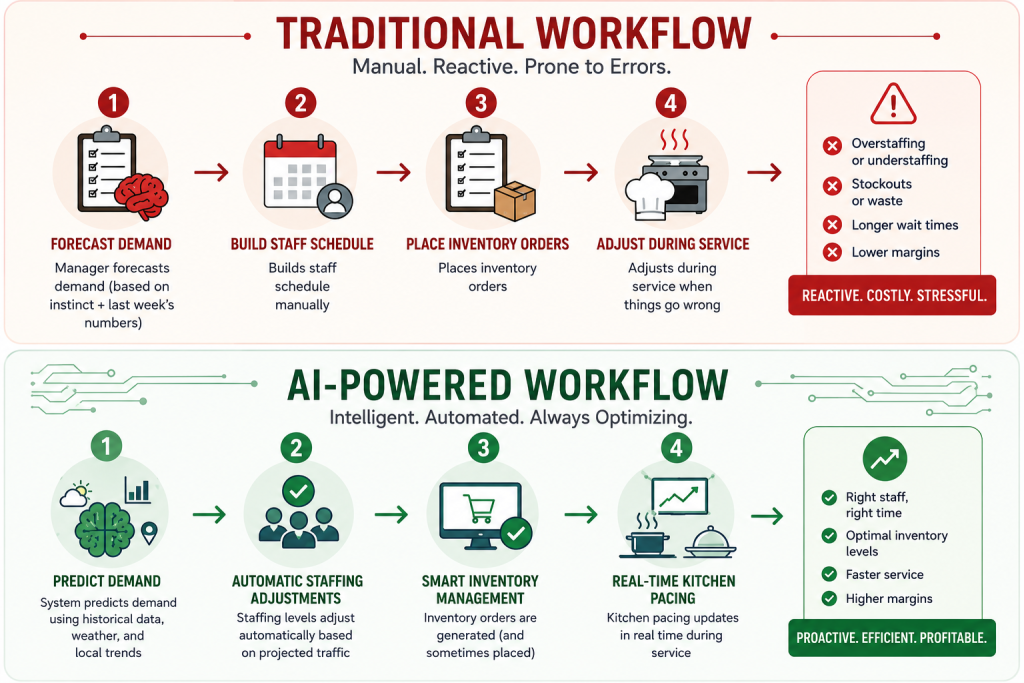
No single step is revolutionary. But together? That’s a completely different operation.
AI is increasingly handling “high-frequency, time-sensitive” tasks, like guest communication, reservations and routine decisions, freeing up staff from constant interruptions.
The Real Payoff: Less Guesswork, More Flow
Restaurants are chaotic by nature. AI workflows don’t remove that, but they reduce the friction.
Here’s where operators are seeing real impact:
1. Smarter forecasting (that actually gets used)
Forecasting tools used to sit untouched because they were too complex or too disconnected. Now they feed directly into scheduling, prep and purchasing.
AI-driven forecasting helps restaurants plan ahead with more accuracy, cutting waste and avoiding understaffing.
2. Inventory that thinks ahead
Instead of reacting to shortages, AI predicts them.
Modern systems track usage patterns, supplier timelines and demand shifts to automate ordering and reduce food waste.
3. Scheduling without the spreadsheet headache
Labor is still one of the biggest cost pressures. AI workflows help balance staffing levels with demand, without managers spending hours tweaking shifts.
The bonus? Better employee experience. No one enjoys last-minute schedule chaos.
4. Orders that manage themselves
Multi-channel ordering used to mean juggling tablets, tickets and chaos.
Now, AI can route, prioritize and pace orders across channels, keeping kitchens from getting slammed all at once.
Why This Shift Is Happening Now
A few years ago, this all sounded expensive and complicated. Today, it’s becoming practical, even for smaller operators.
Three forces are driving the shift:
1. Labor pressure isn’t going away
Restaurants are still expected to do more with leaner teams. AI workflows help automate repetitive tasks like order processing and cleaning, allowing staff to focus on service.
2. Guests expect speed (and personalization)
Customers want fast service, accurate orders and experiences tailored to them. AI delivers all three — often without the guest even noticing.
From personalized menu suggestions to automated upselling, AI is quietly increasing check sizes while improving satisfaction.
3. Too many systems, not enough clarity
Restaurants have been drowning in tools. POS, delivery apps, inventory systems — none fully talking to each other.
AI workflows act as the glue, connecting these systems and turning raw data into usable actions.
The Big Misconception: “We Need to Automate Everything”
You don’t.
In fact, trying to overhaul your entire operation at once is one of the fastest ways to waste money and frustrate your team.
The smarter approach? Start small.
AI automation for restaurants isn’t about replacing your chef with a robot; the real value comes from fixing specific operational pain points – like food waste, scheduling inefficiencies or manual ordering – rather than chasing full automation.
Think of AI workflows as layers, not a switch.
Where to Start (Without Overcomplicating It)
If you’re running a restaurant today, here’s a practical way in:
- Pick one friction point
(e.g., scheduling, inventory or order management) - Measure the cost of that problem
Time, waste, lost revenue — it adds up quickly - Introduce AI into that one workflow
Not across the whole business - Expand only after it proves value
This approach isn’t flashy, but it works. And importantly, it keeps your team on board.
What This Means for Your Team
There’s always concern that AI will replace staff. In reality, it’s doing something more useful: removing the parts of the job people hate.
- Less manual data entry
- Fewer repetitive tasks
- More time for actual hospitality
Automation handles the background noise. Your team handles the guest experience.
That balance matters.
The Bottom Line: Restaurants That Flow Will Win
The next competitive edge in restaurants won’t come from having more data. It’ll come from using that data without thinking about it.
That’s what AI workflows deliver:
- Decisions made faster
- Operations running smoother
- Teams focusing on what matters
The restaurants that figure this out early won’t just be more efficient, they’ll feel easier to run.
And in this industry, that might be the biggest advantage of all.