
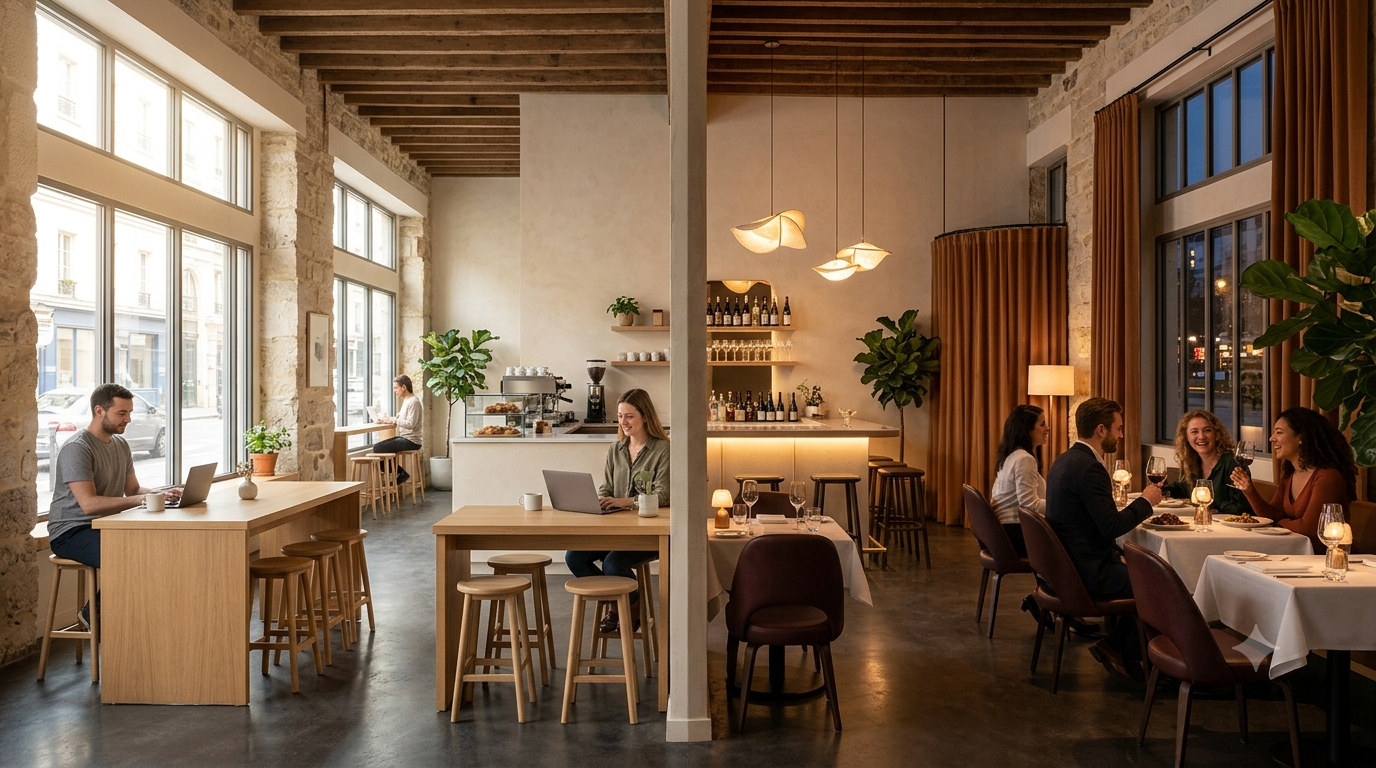
Picture this: It’s 8:00 AM on a Tuesday. Your restaurant is flooded with morning commuters desperately seeking high-quality caffeine and quick grab-and-go pastries. Your staff is operating at warp speed behind a high-volume counter.
Now, flash forward to 8:00 PM. The very same room has shed its bright morning buzz. The lighting is low and intimate, the counter has transformed into a sleek bar and guests are lingering over premium plates and artisanal cocktails.
Welcome to the world of hybrid dining, the operational art of running two completely different restaurant concepts out of a single brick-and-mortar lease.
With commercial real estate prices remaining stubbornly high and labor pools feeling tighter than a pair of raw denim jeans, operators are realizing a harsh truth: letting a beautiful dining room sit completely empty until 5:00 PM is an expensive luxury we can no longer afford.
If you’ve been eyeing your space and wondering how to extract more revenue per square foot without causing your kitchen staff to stage a full-scale mutiny, here is your field guide to navigating the logistical gymnastics of dual-format operations.
The Psychology of the Split Identity
First, let’s address the elephant in the dining room: can one space really wear two hats without confusing the guest?
The short answer is yes — if you treat it like an ecosystem rather than a compromise. Diners are no longer locked into rigid definitions of what a restaurant should be. In fact, industry analysis on Trend Hunter’s Dual-Format Dining Report highlights how top brands are successfully separating high-throughput takeaway occasions from experience-led evening hospitality within concentrated footprints.
The secret lies in clean execution. Consider a hypothetical spot called The Daily Grind & Gather. In the morning, it’s a neighborhood lifeline for oat milk lattes and artisanal breakfast sandwiches. At night, it mutates into an intimate natural wine bar with a rotating small-plates menu.
The guests aren’t confused because the value proposition shifts cleanly with the position of the sun. The commuter gets speed and portability; the evening diner gets atmosphere and extended pacing.
The 60-Minute Flip: Mastering the Physical Transition
The biggest operational hurdle of the hybrid model isn’t the menu; it’s the physical transition window. You have exactly one hour between the end of afternoon service and the start of dinner to completely change the vibe.
How do you pull off this daily magic trick without driving your floor managers to tears? It comes down to deliberate design and modular infrastructure.
| Element | Day Format (Cafe/Counter) | Night Format (Bistro/Wine Bar) | The Operational Trick |
| Lighting | Bright, natural, high-energy | Low, warm, intimate | Programmable smart bulbs with zone controls. |
| Seating | High-turnover communal tables | Cozy, tucked-in two-tops | Modular tables on lockable casters that rearrange in seconds. |
| POS View | Quick-pay counter layout | Full-service table management | Digital POS profiles that toggle service models instantly. |
Pro-tip on ambience: Do not underestimate the power of olfactory and auditory cues. Changing the playlist from upbeat indie-pop to low-fi jazz, dimming the lights and switching the counter-top display from a pastry case to a curated bottle display completely resets consumer expectations the moment they walk through the door.
Tech Integration: The Central Nervous System
Trying to run a dual-format restaurant on legacy software is an express ticket to operational chaos. Your morning operation requires rapid-fire transactional processing, while your evening shift demands careful reservation tracking, coursing intervals and tab splitting.
Flexible spaces that switch functions throughout the day are ranked among the most critical hybrid concepts for modern business survival. To make this structural fluidity work seamlessly, your backend systems must keep up.
This means investing in an agile, cloud-based infrastructure. The modern hybrid architecture must effortlessly route diverse revenue streams — whether it’s an online pre-order for a morning croissant or a server’s handheld terminal ticket for a prime ribeye — directly to the Kitchen Display System (KDS) without creating data fragmentation.
When your tech stack can dynamically switch from a counter-service workflow to an à la carte table layout with a single click, your cross-trained line cooks won’t skip a beat.
Kitchen Logic: Designing a Dual-Purpose Line
Speaking of the kitchen, how do you prevent your back-of-house team from burning out when managing two distinct culinary identities?
You do it by enforcing strict ingredient crossover and equipment efficiency. If your morning menu relies on heavy baking and high-speed convection ovens, your evening menu should pivot toward techniques that utilize entirely different stations, like cold prep, charcuterie networks or range-top execution.
A Quick Hypothetical Case Study:
- The morning prep: The kitchen roasts batches of seasonal mushrooms for a high-volume breakfast wrap.
- The evening crossover: Those exact same roasted mushrooms are folded into a rich, high-margin fontina arancini dish for the dinner menu.
By reusing core ingredients across both dayparts in completely different culinary contexts, you maximize your ordering power, drastically minimize inventory spoilage, and keep your total prep list tight and manageable for a lean kitchen crew.
The Takeaway
Hybrid dining isn’t just a clever layout gimmick; it’s a robust financial hedge against the volatility of the modern hospitality landscape. By unlocking hidden dayparts and transforming your physical square footage into a multi-functional ecosystem, you protect your business from off-peak slumps and squeeze maximum utility out of your lease.
Yes, balancing two operational identities requires meticulous planning, an agile tech setup and a highly synchronized staff. But when the clock strikes 5:00 PM, the lights go down and the cash register keeps right on ringing, you’ll realize that wearing two hats is the smartest look in the business.