
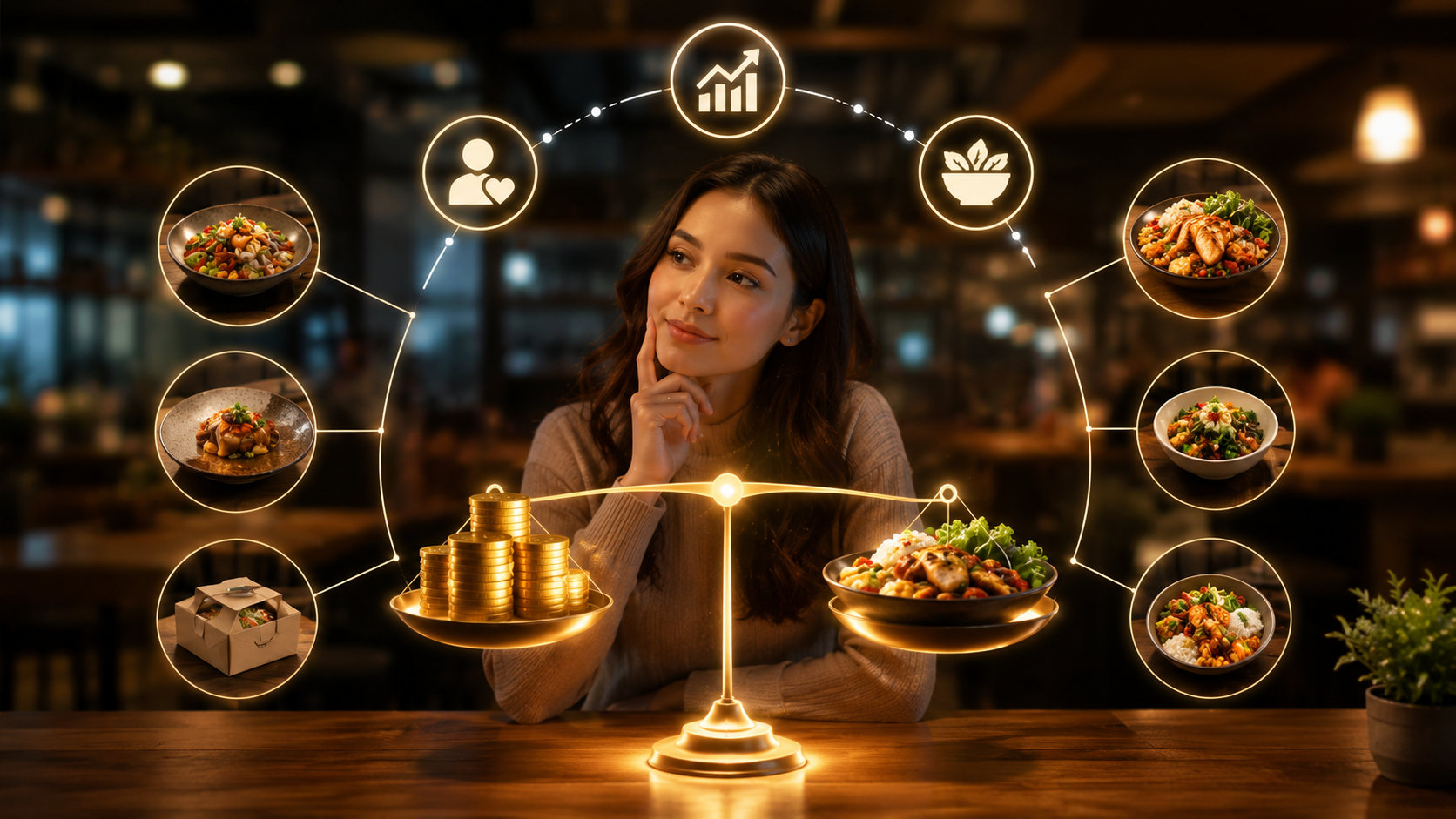
Let’s start with a simple question: when a guest looks at your menu today, what are they really evaluating?
It’s not just price anymore. It’s worth.
In 2026, diners aren’t just asking “Can I afford this?” They’re asking, “Is this worth it? Right now, for me?” That subtle shift is forcing restaurants to rethink everything from portion sizes to menu design to how value is communicated.
And if you get it right, you don’t have to be the cheapest option in town.
Value Isn’t About Being Cheap (And It Never Really Was)
There’s a temptation — especially when traffic dips — to slash prices or roll out aggressive discounts. But that approach is losing steam.
Today’s diners are more selective, not just more price-sensitive. Research shows that affordability still matters, but value now includes quality, portion balance and clarity on the menu — not just lower prices (KRIQ).
Think about it this way:
- A $12 burger with great ingredients, fast service and a clean experience feels like value
- A $9 burger that’s inconsistent or slow? Not so much
Same category. Different perception. And perception is everything.
Why Diners Are Recalculating Every Meal
There’s a bigger economic story behind this shift. Restaurant prices have been rising faster than grocery prices for a while now, making eating out feel like more of a considered decision. At the same time, many consumers are pulling back on discretionary spending, including dining out.
That’s created a new kind of diner:
- More intentional
- More selective
- Less loyal to habit
In fact, many consumers are actively cutting back on restaurant visits and prioritizing affordability and convenience. Which means every visit has to justify itself.
The $3 Taco That Changed the Game
Take Chipotle’s recent move. Instead of pushing premium items, they introduced smaller, lower-priced options like a $3.50 taco and a budget-friendly protein cup.
The result? Traffic went up, even though average spend per visit dipped slightly.
That’s the value equation in action:
- Lower entry point
- Flexible spending
- More reasons to visit
It’s not about making everything cheaper. It’s about giving customers control over how much they spend.
The Rise of “Build-Your-Own Value”
This is where things get interesting. Instead of rigid combos or fixed pricing, restaurants are giving guests more ways to shape their own experience.
You’ve probably seen this already:
- Smaller portion options
- Add-ons instead of bundled meals
- Tiered menu pricing (basic → premium upgrades)
Even the classic “value meal” is evolving. Traditionally, it bundled items together at a lower cost to drive sales. Now, it’s being reimagined with more flexibility and customization.
A guest might:
- Order a base dish
- Add a protein
- Skip the drink
- Upgrade the side
Same menu. Completely different spend levels. That flexibility feels like value, even if the final bill isn’t dramatically lower.
Portion Size Is Becoming a Strategy, Not a Standard
Here’s something operators don’t always talk about openly: portion size is one of the most powerful levers in perceived value. But bigger isn’t always better anymore. Some guests want:
- Smaller, more affordable options
- Lighter meals
- The ability to try multiple items
Others still want:
- Generous portions
- Shareable plates
- “I got my money’s worth” moments
Smart operators are designing menus that cater to both.
Example:
A casual dining concept might offer:
- A full-size entrée at $18
- A half portion at $12
- A combo (half + side) at $15
Same kitchen. Same ingredients. Different value perceptions.
Why Discounts Alone Aren’t Working Like They Used To
Remember when promotions like “endless shrimp” or deep discounts would pack a restaurant? That’s getting harder to pull off. Even when some chains bring back classic deals, the response isn’t always as strong — partly because customers are weighing overall value, not just price. There’s also a fatigue factor: if everything is always “on deal,” nothing feels special.
Instead, operators are shifting toward:
- Limited-time offers with a clear story
- Bundles that feel curated, not discounted
- Menu items designed to look like a smart choice
It’s less about shouting “cheap” and more about signaling “smart.”
Menu Design Is Doing More Heavy Lifting Than Ever
If value is perception, then your menu is the stage where that perception is built.
Operators are getting more intentional about:
- Highlighting “best value” items
- Using anchors (premium items that make others look reasonable)
- Simplifying choices to reduce decision fatigue
Because here’s the reality: a confusing menu doesn’t just slow ordering, it erodes value. When guests aren’t sure what to pick, they default to caution. And cautious diners spend less.
The Middle Is Getting Squeezed
One of the clearest trends right now? Restaurants that don’t clearly define their value proposition are struggling.
The market is splitting:
- Value-driven concepts (clear affordability, convenience)
- Experience-driven concepts (premium, memorable, differentiated)
Everything in between is under pressure.
Operators who succeed are the ones who can clearly answer: why should someone choose us – right now? Because if you can’t answer that, your guest won’t either.
What This Means for Your Restaurant
You don’t need to overhaul your entire menu tomorrow. But you do need to rethink how value shows up in your business.
Start here:
1. Audit your menu through a guest lens
Not “What does this cost us?”, but “What does this feel like to the guest?”
2. Offer entry points
Give customers a way to spend less without leaving disappointed.
3. Design for flexibility
Let guests scale up or down based on their budget and appetite.
4. Focus on clarity
If guests don’t understand your menu quickly, they won’t see the value in it.
5. Stop competing only on price
There will always be someone cheaper. That’s not a winning strategy.
The Bottom Line: Value Is a Feeling, Not a Number
The restaurants winning right now aren’t necessarily the cheapest.
They’re the ones that make guests feel like:
- They made a good choice
- They got what they paid for
- They’d happily come back
That’s the real shift.
Value isn’t about lowering prices. It’s about raising confidence in the purchase. And the operators who understand that? They’re the ones guests keep choosing — even when budgets are tight.