
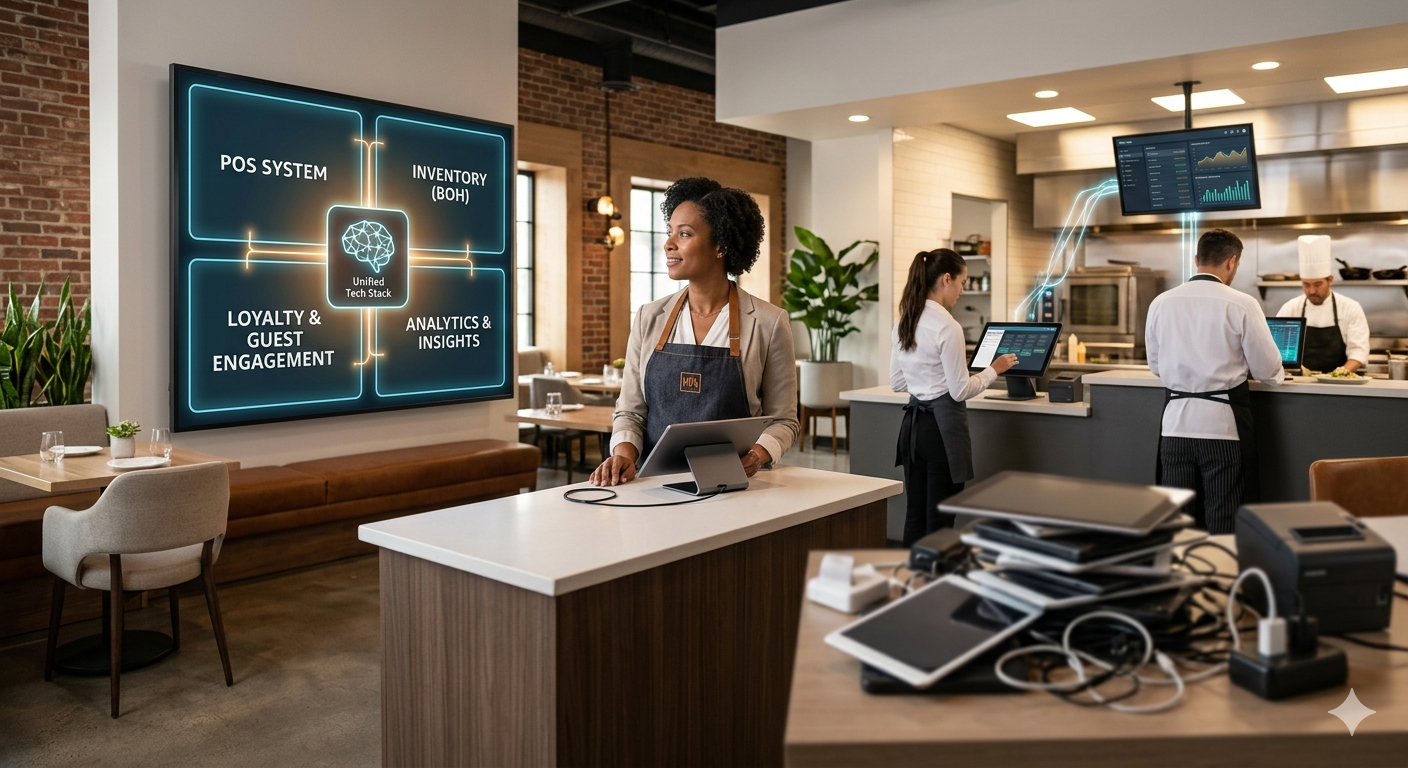
Let’s be honest: most restaurant owners didn’t get into this business because they loved managing software. You got into it for the food, the people and the rush of a perfectly executed service. Yet, if you look at your manager’s office today, it’s likely a graveyard of tablets, different charging cables and sticky notes with five different passwords for five different systems.
For years, we’ve been told that “there’s an app for that.” Need to track steak weights? Get an inventory app. Want to reward regulars? Sign up for a loyalty platform. But as these layers pile up, they start to work against each other. This patchwork — often called a “Franken-stack” — is officially reaching its expiration date. The industry is moving toward unified tech stacks where the POS inventory, and guest data live under one roof. It’s not just about being “high-tech”; it’s about finally getting your time back.
The Death of the “Franken-stack”
A fragmented system is like a kitchen where the line cooks speak different languages and refuse to share notes. Your POS might record a sale, but if it doesn’t instantly talk to your inventory software, your stock levels are always a step behind. If your loyalty program doesn’t sync with your guest data, you’re missing the opportunity to personalize the dining experience in real-time.
The manual labor required to bridge these gaps — exporting CSV files and reconciling data at 2:00 AM — is a massive drain on leadership. Beyond the time lost, there is a data lag. By the time you identify a trend in a fragmented system, the opportunity to act on it has often passed. Modern operators are realizing that integrated technology is the backbone of operational efficiency, allowing for real-time adjustments that protect razor-thin margins.
Why Integration is the New Standard
The transition toward a unified ecosystem offers three transformative advantages:
1. One version of the truth
In a unified stack, data flows seamlessly from the front of the house to the back. When a customer orders a ribeye, the system automatically deducts that weight from your inventory and updates your theoretical food cost. There is no guesswork. You gain a single source of truth that allows you to make decisions based on what is happening now, not what happened last week.
2. Frictionless guest experiences
Today’s diners expect a cohesive experience whether they are ordering via a kiosk, a mobile app or a server at the table. A unified system ensures that loyalty points earned on a mobile order are instantly available for an in-person visit. Unified commerce has been gradually reshaping how restaurants engage with customers, moving away from siloed transactions toward continuous relationships.
3. Operational efficiency and staff retention
Your staff didn’t join the hospitality industry to become data entry clerks. Fragmented systems often require servers and managers to navigate multiple interfaces, leading to errors and frustration. A unified interface reduces the training curve and allows your team to focus on what they do best. When systems “just work”, employee burnout decreases and service speed increases.
The Analytics Advantage
Perhaps the most compelling reason to move toward a unified stack is the power of predictive analytics. When your labor data is layered over your sales data and inventory trends, the system can begin to tell you the future. It can suggest when to cut labor based on historical weather patterns or alert you to a potential waste issue before it ruins your P&L for the month.
In a fragmented world, you are a historian, looking at past data to figure out what went wrong. In a unified world, you are a strategist, using live data to ensure things go right.
How to Start the Transition
If you feel trapped by your current tech stack, the path to unification doesn’t have to happen overnight, but it does require a deliberate plan:
- Audit your “API health”: Look at your current vendors. Do they have “open APIs” that allow them to talk to other systems, or are they “walled gardens”?
- Identify your core: Choose a modern, cloud-based POS that was built with integration in mind. This will be the “brain” of your operation.
- Consolidate gradually: Start by integrating the two areas that cause the most manual work, usually POS and Inventory.
Future-Proofing Your Floor
The era of the standalone software tool is ending. To thrive in an increasingly digital landscape, restaurant operators must trade their fragmented toolkits for a unified vision. By streamlining your technology, you aren’t just saving time; you’re building a foundation for a business that actually runs itself, so you can get back to the reason you opened your doors in the first place.