
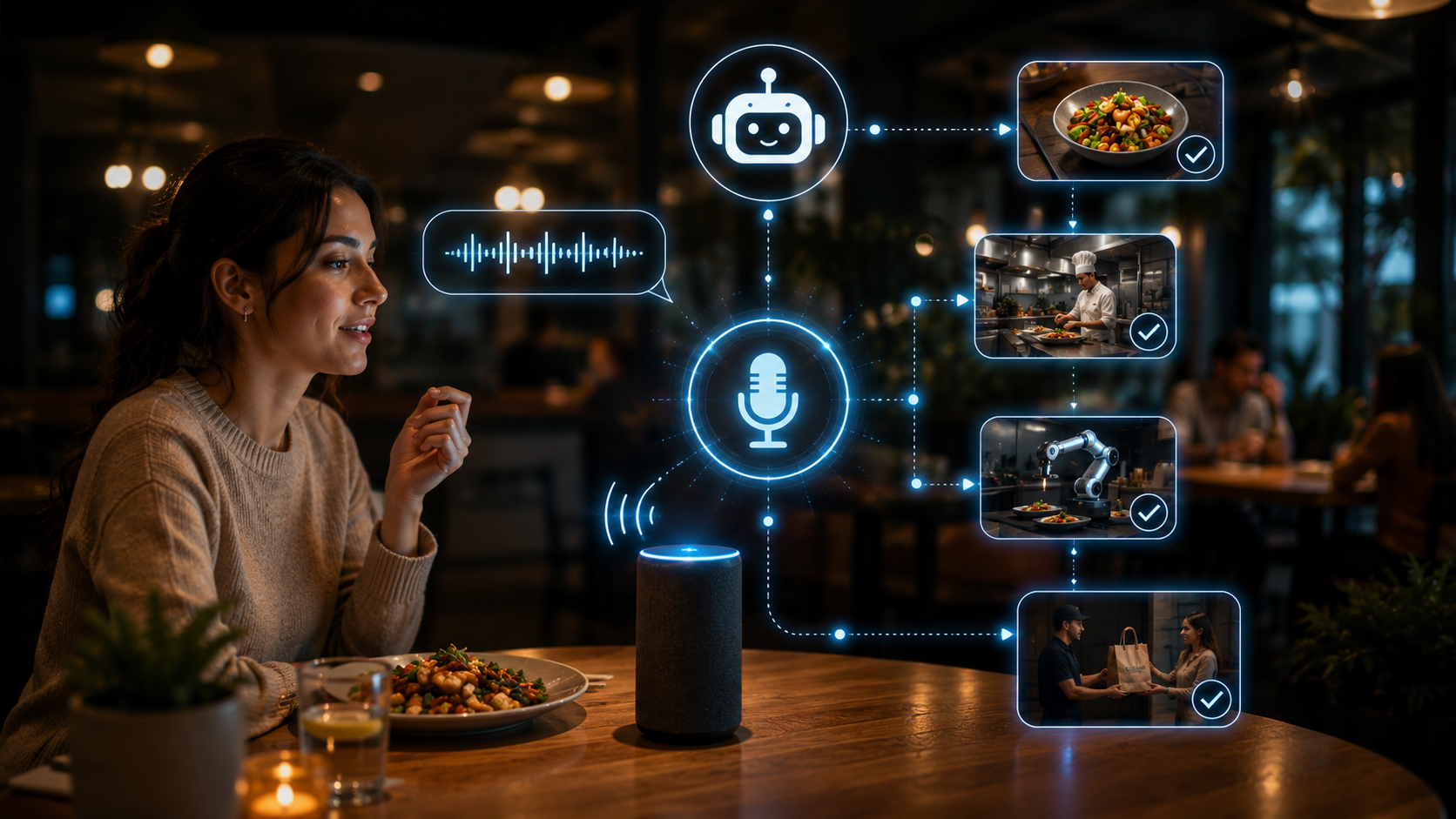
There was a time when digital ordering meant adding an online menu and maybe a delivery integration. Today, that definition feels dated.
The next shift is already underway and it’s far more fundamental. Restaurants are moving toward hands-free, conversation-driven experiences powered by voice AI, chatbots and intelligent assistants. Ordering is no longer tied to screens or staff. It’s becoming something customers simply say.
The question isn’t whether this is happening. It’s how quickly it will reshape day-to-day operations.
From Taps to Talk: A Subtle but Significant Shift
Touchscreens and mobile apps solved one problem: convenience. But they also introduced friction — scrolling menus, navigating modifiers, dealing with clunky interfaces.
Voice and conversational AI remove that layer. Instead of tapping through a menu, a customer can say: “I’ll take two chicken burgers, one without mayo, and add fries.”
Modern AI systems are built to understand these natural, often messy interactions. Advances in natural language processing now allow voice assistants to handle complex orders with high accuracy, including modifications and substitutions, without rigid scripts.
This isn’t just about convenience. It’s about reducing effort. And in a high-frequency category like food, small reductions in effort drive big changes in behavior.
Why Now? The Conditions Are Finally Right
Voice ordering has been discussed for years. What’s different now is execution.
Three shifts are accelerating adoption:
1. Accuracy has reached a usable threshold
Early voice systems struggled with noise, accents and complex orders. That’s no longer the case.
Leading platforms now report accuracy rates exceeding 95%, often matching or outperforming human order-taking during peak hours.
That reliability changes operator confidence. If the system can consistently capture orders without errors, it becomes operational, not experimental.
2. Missed Demand Is Too Expensive to Ignore
Restaurants lose revenue every time a call goes unanswered or a line moves too slowly.
Voice AI directly addresses this gap. Systems can answer every call, process multiple orders simultaneously and operate continuously without breaks.
In practical terms, that means:
- No missed phone orders during rush periods
- Faster drive-thru throughput
- Reduced pressure on front-of-house staff
This is less about innovation and more about plugging revenue leaks.
3. Customer Expectations Have Changed
Consumers are increasingly comfortable interacting with AI in everyday contexts, from virtual assistants to chat-based support.
In restaurants, this is translating into demand for:
- Instant responses
- Seamless ordering
- Personalized recommendations
Where Voice and Chatbots Are Showing Up Today
This isn’t a future-state concept. It’s already being deployed across multiple touchpoints.
Drive-thru ordering
Drive-thru lanes are becoming one of the most active testing grounds for voice AI.
Chains like Taco Bell are rolling out AI-powered systems that adapt menus dynamically and process orders through conversational interfaces, aiming to improve both speed and personalization.
The goal is straightforward:
- Shorter queues
- Fewer order errors
- More consistent upselling
Phone ordering and reservations
The humble restaurant phone is undergoing a quiet transformation.
AI voice agents can now:
- Answer calls instantly
- Take orders
- Book or modify reservations
- Handle common guest questions
This matters because a significant portion of demand still comes through phone channels and customers rarely leave voicemails. If the call isn’t answered, the order is lost.
Messaging and social platforms
Chatbots are expanding beyond websites into platforms like WhatsApp and Instagram. With over 60% of orders now originating through digital channels, conversational AI is becoming a natural extension of how customers already interact with brands.
Instead of downloading another app, guests can:
- Message a restaurant
- Ask questions
- Place orders
All within a familiar interface.
The Operational Impact: Less Friction, More Throughput
For operators, the appeal isn’t novelty, it’s efficiency. Voice and conversational systems improve operations in a few key ways:
1. Parallel processing
AI can handle multiple interactions simultaneously. A single system can take several orders at once — something no human team can replicate during peak hours.
2. Consistency under pressure
Human error increases during busy periods. AI doesn’t tire, rush or forget modifiers. Every order is processed with the same structure and confirmation steps.
3. Built-in upselling
Conversational AI can suggest add-ons naturally: “Would you like fries with that?” Done consistently, this increases average ticket size without relying on staff training or timing.
4. Staff reallocation
Instead of answering phones or managing repetitive queries, staff can focus on:
- Food quality
- Guest interaction
- Service speed
This is particularly valuable in an environment where labor remains one of the biggest constraints.
The Gap Between Interest and Adoption
Despite the momentum, adoption isn’t universal — yet.
Recent data shows that while a majority of restaurants are exploring AI, only a small percentage are using it for customer-facing tasks like ordering or reservations.
That gap creates an interesting dynamic:
- Early adopters gain a clear operational advantage
- Late adopters risk falling behind as customer expectations evolve
In other words, the competitive window is still open, but not indefinitely.
The Challenges Operators Shouldn’t Ignore
The technology is improving, but it’s not without friction.
1. Edge cases still exist
Unusual requests, strong accents or highly customized orders can still trip up systems. The best implementations include fallback options: routing complex cases to human staff when needed.
2. Brand experience matters
A poorly designed AI interaction can feel frustrating or impersonal. Tone, pacing and conversational flow need to reflect the brand, not just function correctly.
3. Integration is critical
Voice AI doesn’t operate in isolation. It needs to connect seamlessly with:
- POS systems
- Kitchen workflows
- Inventory and menu data
Without that integration, efficiency gains quickly disappear.
So, Are We Entering a Hands-Free Era?
Not completely, but we’re moving in that direction. What’s emerging isn’t a fully automated restaurant. It’s a hybrid model where:
- AI handles high-volume, repetitive interactions
- Humans focus on hospitality and problem-solving
The most effective operators aren’t replacing staff with AI. They’re using AI to remove bottlenecks.
The Bottom Line
Voice ordering, chatbots, and AI assistants are not standalone features. They’re part of a broader shift toward frictionless operations.
For customers, that means:
- Faster interactions
- Less effort
- More personalized experiences
For operators, it means:
- Captured demand that would otherwise be lost
- More efficient teams
- Smoother service during peak hours
The hands-free restaurant isn’t a distant concept. It’s already taking shape,one conversation at a time.