GEN Z : High-touch Preferences of Digital Natives, Almost Instantly!

Why is it, that members of Gen Z seem to want to party like it’s 1999? After all, they’re the tech-savvy digital natives who’ve never seen a payphone. They’re the generational cohort born between 1997 and 2012 that the Pew Research Center has dubbed “Post MILLENNIAL,” which makes me wonder how to account for the following:

  • The Philadelphia Inquirer reports that Gen Z still prefers shopping in stores vs. using their laptops. It states that 55% of Gen Z women and 40% of Gen Z men like shopping the old-fashioned way, and two-thirds of them do so for fun at least once a month.
  • An app called Huji Cam, which makes photographic images look old-school and grainy, as if they’d been shot by a disposable camera, has been downloaded more than 16 million times by teens who want their photos to look less staged and more authentic. New York magazine tut-tutted about its fake vintage imagery and noted that the time stamp in the bottom right can be set to today’s date in 1998. Which, by my reckoning, is before most of its users were born.
  • Last December the Chicago Tribune asked the rhetorical question “Why are Christmas cards still a thing?”— opining that the reason sales of greeting cards have remained fairly stable at around 6.5 billion per year is that they offer users a “tactile connection.” 

And speaking of tactile, there’s Trader Joe’s Fearless Flyer. Printed on newspaper stock and using goofy-cute retro images to promote specials like the current Coconut Cold Brew Concentrate, it is described by company execs as a cross between Consumer Reports and Mad Magazine. I grab my copy in store, but many enthusiasts receive it by mail; and I’m talking about the U.S. Postal Service here, Bret, not a digital mailbox. 

  • Then there’s the study cited recently in Specialty Food News that says traditional television continues to exert the strongest influence on purchasing behavior, with 56% of consumers noting TV as their key source of awareness about goods and services. This data exists cheek by jowl with reams of research testifying to the enduring popularity of paper coupons and catalogs. 

We probably shouldn’t be surprised by this back-to-the-future behavior, since we’ve been talking for some time about the necessity of high-touch initiatives to offset restaurateurs’high-tech experiments. This is what all of the factoids above have in common, I believe: They represent a familiar, hands-on connection between buyer and seller in reaction to encroaching digitization. 

Isn’t this the true driving force behind the continued growth of fast-casual operations? Their make-to-order-in-front-of-the-customer model is precisely in tune with connection-craving customers. It’s the coffee-making baristas, ice-cream-shop scoopers and pizza-dough spinners who create a tangible bond between brand and patron. 

These transactions are happening even as invading hordes of robotic pizzamakers and burger flippers are advancing upon us, and it raises some obvious questions.  When and under what circumstances will patrons find them acceptable, and what will the operator need to do to make them so? And I wonder, Bret, if you’ve seen any outstanding examples of the touchy-feely, throwback marketing ploys that consumers, especially younger ones, seem to desire? 

Not sure that young people go to fast-casual restaurants for a tactile, personal experience. Think the rise of that segment — which is exaggerated, anyway, as it only accounted for around 19% of sales among the 200 largest chains in 2018, according to Nation’s Restaurant News’ Top 200 data (12% if you don’t include Starbucks) — has more to do with the growing desire of consumers to customize everything in their lives. Think they line up, or, increasingly, place online orders, for those malleable meals because of the ever-changing dietary restrictions they place on themselves.

Many fast-casual chains evolved in the current environment of allergy-prone, gluten-avoiding flexitarian diners and are programmed to respond to their requests. Their customers want what they want when they want it, but I don’t think they’re expecting a bonding experience with the salad maker at Sweetgreen, the bean scooper at Qdoba or the pizzaiolo at MOD Pizza.

For that you have restaurants that offer more than food and drinks. That includes “eatertainment” concepts such as Dave & Buster’s and Punch Bowl Social, as well as the growing number of craft brewery tap rooms that lure customers with the romance of eating and drinking where their beer is made. 

Those restaurants provide space for youngsters to spend time with their friends, or for them to identify with a restaurant’s personality, giving them “high-touch” experiences, to borrow from your terminology.

As an aside, despise the term Gen Z. It makes them sound like the last generation we’ll ever have, or possibly zombies.

As you know, they got the name because they’re two generations behind my own demographic, Gen X, a generation that was given such short shrift that we were never even given a proper name. The Baby Boomers just put an X over us, declared us an irrelevant mystery and went on to their own children, the Millennials.

Members of Gen Z — prefer iGen, because they don’t remember a world before the iPod, or Digital Native which is less brand-specific — seem to be markedly different from Millennials. I Have to admit I have a bias in favor of them, because, although I don’t have children of my own, they’re my nieces and nephew and the offspring of my friends. Unlike Baby Boomers and Millennials, we were never the dominant force in contemporary culture and we acquired a certain humility, or at the very least a bit less narcissism, than our elders and youngsters. I think maybe we passed that on to our kids.

“Millennials are about the selfie; Gen Z is about the story.”  

That has to do in part with how social media has evolved in recent years, from quick bursts of microblogging on Twitter and Facebook to the more involved video and graphic montages that migrated from Snapchat to Instagram (and thence I believe to Tik Tok, although I’m too old to know for sure), but it also has to do with a more pronounced communal engagement. 

Maybe because they’ve had all human knowledge at their fingertips since practically the day they were born — one of my Digital Native niece’s first words was “pooter,” for “computer” — they’ve taken the time to dig deeper and understand things better. 

There’s no novelty in electronics for them, but IRL (“in real life”) shopping, hand-written cards and tactile things like knitting, which is increasingly popular, or those fidget spinners from a couple of years ago, seem to really strike a chord, just like they do for you and me (Okay, I never really got fidget spinners).

That means for restaurateurs is that they should avoid thinking of Digital Natives, or Millennials for that matter, as a different and inscrutable life form, and instead follow the Golden Rule and treat them as they’d like to be treated. The digital bells and whistles are now just a part of doing business, but I’m thankful that it looks like the human touch will never go out of style.

Turn your QSR Managers Satisfied with Order Ahead from Zero to Hero

As Small Business (SMB) Week kicks off, small business owners are generally optimistic about the future. A majority (54.0 percent) expect revenue increases, a slightly higher number than felt the same enthusiasm this time last year.

How does this translate to the restaurant industry?

Though big names make the headlines, not all QSRs are McDonald’s or Taco Bell. PYMNTS Restaurant Readiness Index has took a look at innovation adoption among QSRs, by business size, in the, a Bypass and Bank of America Merchant Services collaboration.

From drive-ins to drive-thrus to behind-the-scenes streamlining, QSRs have always embraced innovation. However, in the Restaurant Readiness Index, the average restaurant score was 38.7 on a scale of zero to 100.

Speed is the leading reason that QSRs innovate (77.4 percent), while 62.4 percent cited convenience. Both of these factors play into improving the customer experience, which was the motivation for innovation among three-fourths (74.4 percent) of operators.

QSR managers and customers had different opinions on the importance of select features, though. For future success, customers say features that ensure the accuracy of orders are the most important (88.1 percent), while managers (80.3 percent) mostly agreed. The biggest gap (44.4 percent) concerned the importance of self-serve kiosks. Nearly three-fourths of QSR customers thought they were important compared to only 29.5 percent of managers. Online or app ordering also had more enthusiasm from customers than managers.

Managers and customers also didn’t see eye-to-eye about ordering methods. Managers put more faith in traditional ordering methods, like at the counter in-store and at a drive-thru, while customers are more satisfied ordering through apps, either branded or third-party.

QSRs’ offering of ordering and payment methods depends on the size of the chain. Small QSRs were far less likely to have a mobile app for ordering (30.7 percent) compared to medium or large QSRs. Counterintuitively, small QSRs were more likely to offer ordering via third-party apps (31.7 percent) than medium or large QSRs. The higher tendency to partner with a third party is likely because of the lack of their own apps.

For instance, Auntie Anne’s doesn’t enable mobile ordering on its own app, but does through DoorDash. Shake Shack has its own sales-boosting mobile app, but still partners with DoorDash. Even niche players like food trucks, the ultimate small business, have options like QuickByte to offer mobile ordering to customers.

Large chains are also far more likely to accept mobile wallet payments like Apple Pay or Google Pay as compared to smaller chains. Nearly half (49 percent) of large QSRs allow payment within their app, while 31.2 percent of medium chains and only 21.8 percent of small chains do.

Small chains have the highest number of customers ordering and picking up in the same location (66.3 percent), while drive-thrus are the most commonly used at large QSRs (40.3 percent), which are also more likely to offer them.

Satisfaction was high among managers and customers at small QSRs for in-store ordering and pickup. Small QSR managers were very satisfied with in-store fast pick up where customers might order ahead and skip the line: 91.4 percent cited satisfaction, higher than the satisfaction levels among large QSR managers (85.1 percent), as well as customers of small QSRs (46.2 percent). This is a reflection of long lines being a pain point particular to small QSRs.

Innovations like mobile ordering and payment apps have tangible benefits for customers, but not all innovations are readily apparent. Kitchen automation systems (KAS) facilitate the order fulfillment process so workers can readily see orders on a tablet or mobile device.

Over one-third (36.0 percent) of QSRs in the study had already implemented such a system, with small QSRs having a lower rate of implementation (33.7 percent). Reducing order time was the leading reason that small QSRs (41.7 percent) implemented a KAS. But more than half (51.9 percent) cited satisfaction with their current system as to why they hadn’t implemented a KAS. Larger chains were more likely to cite expense as a barrier.

In the study, even large national QSRs had varying levels of KAS implementation. Burger King had the highest adoption rate (64 percent), while Subway had the lowest (10 percent).

Just 4.2 percent of small QSRs considered lower costs as a benefit for adopting KAS technology. Despite positive outlook among small businesses, generally, small QSRs are still hesitant to invest in technology with an uncertain return on investment.

UBER Is Bound To Make Starbucks delivery an Impact Across US

Up until now, the Starbucks Delivers program had only been in a test phase, available in 11 select markets including Miami, Seattle, Boston, Chicago, New York, Washington D.C., San Francisco, Los Angeles, Orange County, Houston and Dallas.

Starbucks has announced plans to make Starbucks Delivers available throughout the U.S. in early 2020.

The coffee giant is continuing its partnership with Uber Eats to expand after launching an 11-market rollout last year.

“We are driven to create new and unique digital experiences that are meaningful, valuable and convenient for our customers,” Roz Brewer, group president and chief operating officer for Starbucks, said in a press release. “Partnering with Uber Eats helps us take another step towards bringing Starbucks to customers wherever they are.”

Through its agreement with Uber Eats, the companies will work on innovation and technology integration while continuing to focus on delivery packaging, in-store operations, and a quick order-to-door delivery window.

About 95% of the Starbucks menu will be available through the mobile delivery app, excluding items with foam like macchiatos and cappuccinos, which the company said don’t hold up well during the delivery process.

Along with being the preferred delivery partner, Uber Eats will also collaborate with Starbucks on delivery technology and innovation, the company said.

“Our customers are huge Starbucks fans and love being able to get their favorite items delivered with Uber Eats speed,” said Jason Droege, vice president of Uber Everything. “We’re excited to expand our partnership across the United States to make ordering their favorite coffee and breakfast sandwich as easy as requesting a ride.”

Customers can place their Starbucks order via the Uber Eats mobile app on iOS and Android devices, and even follow their order’s progress within the app. Starbucks has also developed packaging to help ensure the quality of hot and cold menu items.

The service was first tested out in Miami, and although not all drinks are available for delivery, Starbucks noticed that customers make larger orders when they get their drinks delivered. “We’re seeing an expanded ticket. And that average ticket is what we need to see happen as we approach delivery,” said CEO Kevin Johnson at the time.

Starbucks already has a successful delivery service in China, delivering in 17 cities in the country in 1,100 stores after launching in September in Shanghai and Beijing. With more than 3,000 stores already in operation in the country, another 2,000 are slated to open by 2021.

What Is Restaurant Table Turn Over and How Does It Work?

formal table setting

In the eatery business, table turnover rate is precarious to ace: you need to situate however many gatherings per feast administration as could be allowed, yet you would prefer not to make your clients feel surged or overlooked. Most easygoing eateries intend to turn each table multiple times all through a supper administration, or once consistently and a half. While this sounds basic enough, it tends to be hard to accomplish when no doubt about it “campers,” or burger joints who keep on remaining situated at their tables long after they’ve paid their checks. This kind of client can contrarily affect a café’s course through rate, which at last brings down benefit. To help expand table turnover in your café without appearing to be unwelcoming, make certain to pursue a portion of our tips beneath.

Fine Dining Vs. Casual Dining

Perhaps the greatest factor to consider before putting any of the tips beneath without hesitation is whether you claim an easygoing or high end foundation. While most easygoing eateries center around higher course through rates, white tablecloth organizations are increasingly worried about client experience. If it’s not too much trouble note that the majority of these tips apply for the most part to easygoing eating foundations, however they can in any case be adjusted and utilized in your high end café to expand table turnover rates.

1. Have an Organized Seating System

One approach to amplify table turnover is to have a sorted out seating and reservation framework. With the end goal for this to occur, there must be extraordinary correspondence among servers and hosts. When a server gathers the check and flag the busser to begin tidying up tables, they should caution the hosts that their table will open up in all respects in no time. This will enable the host to assemble the following party in line and have them prepared to be situated very quickly. The sooner has can get clients to their tables, the less time those tables will sit void. To help improve your seating framework and get clients situated all the more rapidly, pursue a portion of the tips underneath:

  • Pre-dole out tables to visitors holding up in line, so when they open up, visitors can be situated.
  • Have a holding up region close to the host or leader stand, so has can without much of a stretch discover clients when they’re prepared to be situated.
  • There’s nothing more regrettable than considering a gathering’s name on various occasions, just to discover they’re holding up outside.
  • Acknowledge just stroll in clients, so you don’t host to manage no-show gatherings who reserved a spot.

2. Keep Your Serving Staff On Schedule

fine dining server

Another way to keep each party’s dining experience around the one and a half hour mark is to keep your serving staff on schedule. If a server doesn’t show up to a table right away, they’ve already added time to that table’s occupancy. Even worse, nothing’s more aggravating for hungry customers than waiting a long time for their server to come over and introduce themselves, let alone take their orders. We’ve provided some tips below that will help keep your staff on schedule throughout the entire meal:

  • Take drink orders immediately, and bring out water promptly.
  • Ask guests if they’ve dined at the restaurant before. If not, go over some menu highlights. Then, you can simply go over the specials.
  • If a large party is seated, consider having more than one server assigned to the table.
  • Clear off plates as guests finish their meals rather than waiting until they’ve left.
  • Assign more than one busser per table to get the remaining dishes cleared quickly.
  • Keep pre-rolled silverware and clean dishes ready, so tables can be reset quickly.
  • Drop the check off before customers have to ask for it. By placing the check on the table as guests are finishing up their dessert, they won’t have to wait and flag you down when they’re ready.
  • If customers continue to stick around long after their check has been paid, and there’s a long line of waiting customers, it is okay to politely ask them to continue their conversations at the bar, so you can seat another party with reservations.

3. Use Technology to Your Advantage

Although paying the check signals the end of a meal, it’s oftentimes a lengthy task. Servers have to collect credit cards, run them back to the register, print out receipts, and deliver them back to the table. This doesn’t even include the time-consuming tasks of splitting the check at the last minute or using gift cards. Even after you’ve delivered the receipts to the tables, customers still tend to take their time writing out their tips and chitchatting. To help expedite this process, consider investing in a mobile POS system, like Ziosk or Square, if it’s within your business’s budget. By using upgraded technology devices, servers can run credit cards and complete checks right at the table in front of their customers or let customers pay when they’re ready to leave.

4. Update Your Dining Room

restaurant patio seating

If your restaurant is really struggling with turning tables, then consider rearranging your restaurant. Placing tables and chairs in the center of the dining room, away from corners and walls, will encourage customers to eat more quickly. Since the middle of the room is often the busiest and most hectic spot in the restaurant, guests will naturally eat faster. Additionally, patrons tend to linger for a longer period of time if they’re seated on furniture that’s anchored to the ground, like booths. It could be beneficial to seat small parties at smaller tables and chairs rather than in booths. It’s important to note that this is most common in casual restaurants where people are paying for quick service and convenience.

Another update you can make to your dining room is changing its interior color scheme. Bright colors, like red, yellow, orange, and green, raise an individual’s heart rate and blood pressure. This excites them and subconsciously encourages them to eat faster, which results in quicker turnover rates. To adjust your establishment’s color scheme, consider painting the walls a vibrant shade, using bold upholstery, adding pictures and accent pieces, or serving meals on brightly-colored dinnerware.

5. Make Your Menu More Compact

While many restaurant owners believe that offering a larger menu will make customers’ decisions easier, it actually makes them more difficult. When individuals are given an overload of choices, it stresses them out and takes them longer to find something they like. Instead, offer a smaller menu that includes only your most popular options. Feel free to switch up the menu with the seasons or offer three unique specials every week. The point is, the quicker your guests decide what they want, the faster their orders will be put in. This leads to shorter dining times and higher flow-through rates.

By making simple changes to the routines of your servers and hosts, or by updating your dining room layout or menu, you’ll be able to get customers in out and the door in a timely fashion without making them feel rushed or unwanted.

Restaurant News: STARBUCKS FIRST EXPRESS Store in China

Starbucks Corp. continues to push its coffee delivery and retail presence in China with the opening of the company’s first express café — known as Starbucks Now — in Beijing, China that focuses on Starbucks mobile order and pay and delivery customers.

The express café format will also act as a dispatch center for nearby delivery orders, while all Starbucks Now and Starbucks Delivers orders will be placed in secure “pickup portals” along the wall so that customers and couriers can more easily find and pick up their orders.

this new retail format and design approach provides us with a platform to offer customers a fast and convenient retail experience to suit their on-the-go lifestyle.

Beijing-Express-Store_1.png
Image Courtesy : NRN

As Starbucks continues to focus its international efforts on the China markets, the Seattle-based company has been struggling to capture consistent traffic and reported a 1% decline in same-store transactions in China in the second quarter ended March 31.

In order to keep up with quickly growing mobile and delivery-forward competitors in China like Luckin Coffee, which filed in April for a U.S. initial public offering, Starbucks has launched several initiative, including delivery in partnership with Alibaba, which was announced in 2018, and the use of ghost or cloud kitchens — delivery-only kitchens that are not attached to a restaurant — a collaboration with Alibaba and Hema supermarkets.

The minimalist store design of the mobile-forward Starbucks Now locations allows for one or two baristas to monitor both walk-in and order-ahead orders, with only a few stools for seating and little of the hustle and bustle of the typical Starbucks store format. A central kitchen will handle all beverage and food orders during peak hours.

Launch of the first Starbucks Now-store marks the latest milestone in the company’s continued efforts to bring its digital experiences for customers in China through unique and convenient store formats. The company plans to open new Starbucks Now-stores across high-traffic areas including business and transportation hubs as well as to new cities in China.

Toronto owner of Jack’s Family Restaurants sells chain

Toronto-based Onex Corp. said it was selling its stake in Jack’s Family Restaurants Inc. to an undisclosed buyer in a deal that will close at the end of the third quarter. 

Onex bought the Birmingham, Ala.-based quick-service hamburger chain in 2015 for $234 million. The terms of the deal were not disclosed, but Onex said it is more than tripling its investment in the Southeastern chain founded in 1960.

“Over the course of our investment, Jack’s significantly accelerated its growth and brought its differentiated concept, high-quality food and exceptional customer service to new communities across the southern U.S.,” said Matt Ross, a managing director of Onex, in a statement. 

Ross thanked Jack’s CEO Todd Bartmess and his management team for being great partners to Onex.  “We wish them continued growth and success in the future,” Ross said.

Bartmess said Onex has given the regional chain the support to “invest in our people, technology and the growth of our brand.”

“They were steadfast in their commitment to the Jack’s family and the high standards we set.  We’re grateful for Onex’ partnership over the years,” the CEO said in a statement.

Jack’s ranked No. 111 in the most recent Nation’s Restaurant News Top 200 census with an estimated $402.8 million in U.S. systemwide sales for this fiscal year ended December 2018, up 7.7% from $374.1 million in 2017. It ended 2018 with 162 units, up from 147 in 2017.  The company’s restaurants are in Alabama, Tennessee, Mississippi and Georgia.  

NRN research suggested that Jack’s restaurants have average annual sales per unit of about $2.6 million.

A Battersby Chef Is Back With Lamb Ribs and Roasted Lobster

Dover and Battersby, opened in 2011 and 2013 respectively, were two spots that you’d point to as models for the style of new Brooklyn neighborhood restaurants that’s since become almost standard. Run by the chefs Joe Ogrodnek and Walker Stern, they were ambitious but (especially Battersby) small places. After Dover closed in 2017, Ogrodnek skipped town (remaining an owner of Battersby until it, too, closed) and, he says, took a bunch of time off and traveled. He stayed off the kitchen grid until September of last year, when it was announced that he’d taken his career in a new but not uncommon direction: as the chef-partner in a new hotel’s all-day café. Called Floret and located in Atelier Ace’s Sister City on the Bowery, it opened in June for breakfast and lunch and tomorrow will expand to dinner, completing the all-day circle.

“I didn’t really see myself working for, doing a restaurant in hotel,” Ogrodnek says. “It was something I never imagined doing. With Battersby and Dover, I kind of fell in love with the small neighborhood restaurant.”

At Floret, he’s serving a different kind of clientele — people who live on and around the Bowery, sure, but also those visiting for business, family, and fun — and working with a new partner. He serves as the culinary partner — “I’m kind of culinary development lead, I suppose you would call it,” he says — working with the executive chef Andrew Whitcomb on developing dishes, putting the menu together, and training staff. Whitcomb is a less familiar name to New Yorkers, but he has worked for some of the country’s best chefs: He was the chef de cuisine of Dominique Crenn’s Petit Crenn, cooked at Ken Oringer’s Earth at Hidden Pond, and was the executive chef at Claus Meyer and Fredrik Berselius’s now-closed Norman.

The date, pistachio, and almond cigars with honey whipped cream. Photo: Grub Street

Their menu takes an agnostic approach to ingredients and cuisines, serving hamachi crudo with cucumber-melon gazpacho alongside Japanese eggplant with crispy shallots and palm sugar for appetizers. You’ll find some starches like heirloom beans with garlic pistou, and the entrées run the gamut from roasted lobster with ginger, chili, and lime to veal breast with morels and vin jaune to lamb ribs with cucumber-yogurt and mint. There are only three desserts, but the approach is still applied: You can order your chocolate budino with coffee ice cream and have your date, pistachio, and almond cigars, too.

“The menu is definitely international. It’s a question I get asked a lot, and I think is a valid question. ‘What kind of cuisine would you say this is?’ I don’t really know how to answer that question,” Ogrodnek says. “I just think it’s modern. Everything is so easily accessible that we just have the options to do so many different types of cuisines.”

The restaurant has a full bar, including a nice selection of beer (Cigar CityRadebergerKCBC) and cocktails like the Roman Highball, made with amaro, ginger, and lime. It’s also significantly larger than any restaurant that Ogrodnek has run before. There are 186 seats total, with most of them in the dining room that, with its mix dark wood tables, tile floor, and scattered plants, blend old and new nicely. An outdoor space looks and like it could lead to a garden just around the corner, and there’s a private dining room for ten, should you have reason to celebrate.

The Japanese eggplant with crispy shallots, peanuts, palm sugar, and mint. Photo: Grub Street

A crispy whole dorade with grilled summer beans, sesame, sambal, and lime that’s meant for two or one very hungry person. Photo: Grub Street

Chilled peekytoe crab with avocado, scallion, green apple, and lemon. Photo: Grub Street

The Rolls Royce cocktail with gin, sweet and dry vermouth, and Benedictine. Photo: Grub Street

Inside! Photo: Grub Street

And out! Photo: Grub Street

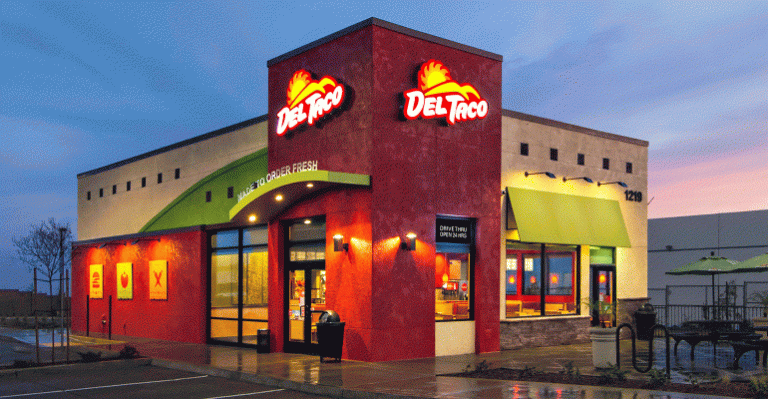
Del Taco Makes Summer a Bit Sweeter With Introduction of $1 Mini Floats

Company Celebrates National Drive-Thru Day on July 24 with FREE Mini Floats for Guests Through the Del Taco App

Del Taco Makes Summer a Bit Sweeter With Introduction of $1 Mini Floats

Del Taco Restaurants, Inc. (NASDAQ: TACO), the nation’s second leading Mexican quick service restaurant,* today announced a sweet product introduction to help guests beat the summer heat. Only a buck each, Del Taco’s Mini Floats will launch nationwide on July 24, National Drive-Thru Day. To celebrate the fun holiday, guests can get a FREE Mini Float all day with any purchase when presenting the coupon in their Del Taco app at check-out.**

Crafted with a combination of Del Taco’s premium Vanilla Shake and a choice of Cherry Coke®, Barq’s® Root Beer, Hi-C® Flashin’ Fruit Punch, Coca-Cola® or Fanta® Orange, Mini Floats are an indulgent treat at a price that only Del Taco can offer.

“With Mini Floats, we’re thrilled to give our guests another uniquely Del Taco way to beat the heat this summer,” said Barry Westrum, Del Taco’s Chief Marketing Officer. “Classic floats are synonymous with summertime, and we’re thrilled to now offer 12 different dollar beverages, including these new, fun and timely drinks.”

Along with Mini Floats, Del Taco’s dollar drink menu is full of guest-favorite offerings, including Real Strawberry Lemonade, Prima Java Iced Coffee (Value Size), 30-Ounce Gold Peak® Brewed Iced Tea and Vanilla, Chocolate and Strawberry Mini Shakes.**

Guests who crave even more value can download The Del App, available on the App (iOS) and Google Play (Android) stores, and will receive a coupon for any taco free,*** as well as other special offers delivered to their mobile device every week.

*By number of units

**Price and participation may vary by location. 
***Limit one sign-up offer per device. Registration required to access deals. Price and participation may vary.

About Del Taco Restaurants, Inc.

Del Taco (NASDAQ: TACO) offers a unique variety of both Mexican and American favorites such as burritos and fries, prepared fresh in every restaurant’s working kitchen with the value and convenience of a drive-thru. Del Taco’s menu items taste better because they are made with quality ingredients like fresh grilled chicken and carne asada steak, hand-sliced avocado, hand-grated cheddar cheese, slow-cooked beans made from scratch, and creamy Queso Blanco.

The brand’s campaign, Celebrating the Hardest Working Hands in Fast Food, further communicates Del Taco’s commitment to restaurant-level team members that provide guests with the best quality and value for their money through cooking, chopping, shredding and grilling menu items from scratch. Founded in 1964, today Del Taco serves more than three million guests each week at its more than 580 restaurants across 14 states. For more information, visit www.deltaco.com.

5 Ways You Can Reinvent Business Data into Business Insights

When you’re running a business that’s growing, it can be hard to have a complete view of your financial picture and overall performance. As you grow and add customers, suppliers and product lines, you need access to the information that matters most to your business. Every member of your team needs an accurate, timely look at what’s most important for their unique role.

01. Put Information to Work.

Knowledge is power. Put real-time, role-relevant information into your team’s hands and they’ll make quick, confident, forward looking decisions for your business.

02. Transform big data into your next big idea.

Turn years of facts and figures – from sales performance to individual transactions – into insight you can easily analyze. Then use it to spot trends and make accurate projections about inventory levels, staffing requirements, or future product trends for years to come.

03. Get BI on the fly

In today’s connected world, work doesn’t happen only in the office. Being productive means having the ability to create, share, and collaborate from virtually anywhere. Get mobile, with access to your data and applications regardless of where you need to be.

04. Connect your people, your processes and your systems

When your calendar, email, and business management solution all work together and data is transferred seamlessly across them you have the ability to deliver the customer experiences that set you apart from your competition.

05. Put the power of the cloud to work for your business

Take the burden out of business intelligence. Use the power of the cloud to choose where you want information, and who you want to access it – then enjoy the flexibility and savings that come along with it.

With a business intelligence platform every get the ability to analyze and manage a massive amount of data. This lets your team do real analysis on years of financial history, sales figures, cost structures, customer information, inventory levels and other business data and make sound projections about what you can expect in the weeks, months and years to come.

Your data is no good if it’s lying dormant on a server somewhere. These platforms lets you get at it and get into it, so you can create the big ideas that make Big Data such a big deal.

The cloud’s promises of accessibility for users and reduced IT workload are more than just marketing speak. They’re real benefits, even for small and mid-sized business. But you have to find the model that makes sense for the data security, storage and ROI needs of your business. If you want to move your business intelligence, financial management and productivity tools to the cloud, great; if you prefer to use a hybrid approach and host only a portion of your solution, super; or if you’re all ready to go all-in.

The reality here is that your approach to the cloud needs to match your business and help determine what makes most sense today and what will set you up best for tomorrow.

Your Key To Success: Millennial with Table Ordering Systems.

Millennial— presently the biggest eatery client section in the U.S. — have an inclination for directing retail and eatery exchanges without addressing a live individual — utilizing a tabletop requesting framework, for instance.

It is likely established in them being the original to grow up with the web and become early adopters of cell phones, which have ingrained the desire that they ought to have the option to get what they need alone time, and immediately.

As opposed to considering this to be an obstruction, canny eateries are transforming this inclination into a positive and grasping more youthful eatery visitors by introducing café tablet requesting frameworks and table-top checkout choices.

Tabletop requesting frameworks put the ball in the visitor’s hands

Keep in mind the thing we just said about twenty to thirty year olds hoping to get what they need individually time? That is one of the elements at the core of the push towards tabletop requesting frameworks and checkouts. A few burger joints need to plunk down, promptly peruse the alternatives, and put in a request as fast as could be expected under the circumstances.

A lot of others want to jump into a discussion and take as much time as necessary without stressing that a server will intrude on them like clockwork to inquire as to whether they’re prepared. In any circumstance, utilizing innovation to give these visitors a chance to make their own feasting timetable is an alluring suggestion.

Eateries are finding subordinate advantages of tablet frameworks

As an eatery proprietor, your essential purpose behind introducing a tablet requesting framework or utilizing any innovation ought to consistently be to make an incentive for your visitors. Yet, that doesn’t imply that the framework shouldn’t have other quantifiable advantages for the organization too.

Café organizations are giving close consideration not exclusively to how these tablets influence the visitor experience, yet in addition what effects they may have on their incomes, expenses, and activities.

Applebee’s, which presently utilizes tabletop requesting frameworks in all of its U.S. areas, says over 70% of their visitors use them during their visit. Outback Steakhouse, in the interim, asserts that their sweet deals have ascended by 30% because of their eatery tablet requesting framework, and a few different chains have detailed higher in general tickets when they are being used.

Table-top innovation is never a substitute for administration

Obviously, most burger joints (particularly more youthful ones) are available to using tabletop requesting frameworks and tabletop checkout frameworks in eateries, and organizations can utilize them as a piece of their in general computerized innovation technique to draw in visitors in various ways.

Pioneers must recollect that this sort of eatery innovation is an instrument to upgrade the administration experience, yet it will never be a swap for a set up and powerful administration culture all through the business. A tabletop requesting framework and different developments can be utilized to draw in twenty to thirty year old, however there is no proof so far to propose that burger joints will forfeit the characteristics they ordinarily ask for from an eating knowledge — well disposed administration and reliable sustenance quality — for innovation.