Everyone has their place: that bar or restaurant they return to again and again. Usually it’s someplace that’s comfortable, close by, and definitely not hot or new. Instead, they offer familiarity and some under-the-radar charm. They’re called neighborhood gems for a reason, so we asked 37 chefs to tell us which spots they think of as their own third place, whether it’s a red-sauce Italian joint or the family-owned Greek diner down the block.
Astoria
“Los Portales Taqueria is open late and has tacos for just $1.65 each. I’ll usually crush three lengua tacos, and order some guacamole and chips (along with their three different hot sauces). Their avocado salad is great, too, if you want a starter or something light. Really, you can’t go wrong with any of the tacos there.” —Arjuna Bull, chef-partner, Luthun
Bay Ridge
“Karam is a Middle Eastern takeout spot on 86th Street and Fourth Avenue that’s always busy. There are a few tables you can hang at, but all the food travels well so just take it to go. Their combo plates, like chicken shawarma or lamb shish kebab with white rice and a house salad, are the move with all of the shawarmas shaved right off the spit.” —Calvin Eng, chef de cuisine,Win Son
Bed-Stuy
“Saraghina is always busy and, as a result, has such a great energy. The atmosphere and service style are relaxed yet attentive, and the food and wine are consistently good. My favorite seats are always at the bar. The bartender works in a very small space with just eight or so seats in front, and it’s easy to appreciate their craft and enjoy a conversation revolving around simple Italian food and standout wines. I am obsessed with Sicilian wines, and every time I’m there it seems they have a new one to try. ” —Jared Braithwaite,chef, Colonie
Brooklyn Heights
“Noodle Pudding has an Italian-American vibe, but the food is very different than you would expect. It leans more regional Italian than typical ‘red sauce.’ They always have really interesting seasonal seafood dishes that use local fish. Some of my favorites have been the razor clams casino, bass cheek salad, and the fried whiting.” —Scott Tacinelli, chef-partner, Don Angie and Quality Italian
Bushwick
“My favorite li’l spot is Mally’s on Knickerbocker and Jefferson, a bodega/taqueria that dropped the bodega part of its business after a few years and just focuses on the food now. They make really great Mexican classics like chilaquiles, huaraches, and tortas, usually cooked by two little ladies in the back with a griddle and not much else. It’s always super fresh (probably because it’s so small that there’s no place to store anything) and seasoned beautifully. The chorizo there is especially good, be it on a tostada or with some scrambled eggs. They’re always so friendly and fast, and it’s the kind of place that just brings you joy when you walk in.” —Jordan Terry, executive chef, Dirty French
Carroll Gardens
“Avlee Greek Kitchen is around the corner from my apartment and I go there at least once a week. It’s comfort food to me: Greek salad, dolmas, pita, and gyro. It’s one of those places where everyone knows each other and remembers your name and go-to orders. The owner is always there, and you can tell that his food is made with love and passion because it’s the food of his homeland. I have been going there for at least seven years.” —Tomer Blechman,chef, Miss Ada
Chelsea
“I love an excuse to shout from the rooftops about my love for Lollino, a Milanese coffee and gelato shop in Chelsea. It’s the type of place that convinces you that you live in a quaint “neighborhood” in the middle of Manhattan. Lorenzo, the owner, takes so much pride and care in everything he produces and it shows; everything feels, looks, and tastes distinctly, authentically Italian. I love the hazelnut sorbet — made from imported Italian hazelnut paste — and the espresso is second to none. The staff will always remember you, and Lorenzo will give you a taste of some new confection he’s working on. It doesn’t hurt that my dog’s name is also Lorenzo, so the two have become best friends.” —Suzanne Dumaine, chef-owner, Three Owls Market
Chinatown
“There’s a food cart run by two ladies on the southwest corner of Canal and Centre Streets that makes an amazing chicken-and-tofu-skin congee that’s very delicate. They have a very loyal following and there’s always a line in the morning. Our usual order is a large congee with a side of fish balls with all the sauces, scallions, and sesame seeds. The only time they don’t show up is when the weather is really bad.” —Hannah and Marian Cheng, co-owners,Mimi Cheng’s Dumplings
Crown Heights
“My favorite spot in Crown Heights is the Islands. The jerk chicken and oxtail are the best I’ve had in the city and it’s the perfect food to grab to go if you’re headed to the park. I’ve been going there for the last seven years and the restaurant is such an institution in the neighborhood — we are lucky to be neighbors with them.” —Nico Russell, head chef, Oxalis
Dumbo
“Thai Sidewalk is a humble, little street cart on the corner of Jay and Front Streets, but people shouldn’t let its unassuming appearance fool them! They serve really solid Thai dishes like pad see ew and green curry with rice, and they make a great homemade Thai iced tea, too.” —Angie Rito, chef-partner,Don Angie and Quality Italian
East Harlem
“I love going to Earl’s Beer and Cheese for their craft-beer selection. They also have the best bar snack: fresh garlic rubbed on hot sourdough toast and topped with crazy-good beer cheese. It’s open late, so it’s chef-friendly and also open Sundays, which makes a brunch date with my three kids possible.” —Ricardo Camacho, executive chef, Añejo
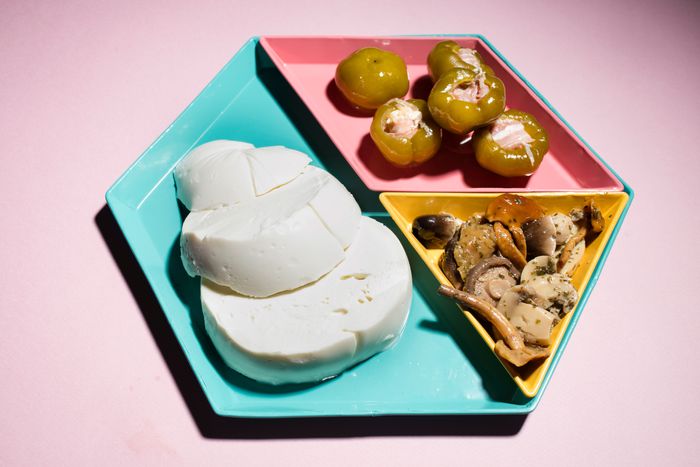
The spread at Russo’s in the East Village. Photo: Melissa Hom
East Village
“Russo’s Mozzarella & Pasta is an Italian deli that’s been in the East Village for over 100 years. It gets passed up on all the reverence held for old New York establishments with flashier fronts, but the best by-the-pound picks are marinated mushrooms, chickpea salad, and spicy peppers stuffed with prosciutto and provolone. I never leave without a house-spun spool of mozzarella marinated in olive oil and herbs, and that’s a rule. Thankfully there is a perpetual tray of prosciutto balls in pyramid formation on the counter, so I know I’m not the only one indulging in this oversize cured-meat-and-cheese bomb.” —Zoë Kanan,pastry chef, Simon & the Whale
Elmhurst
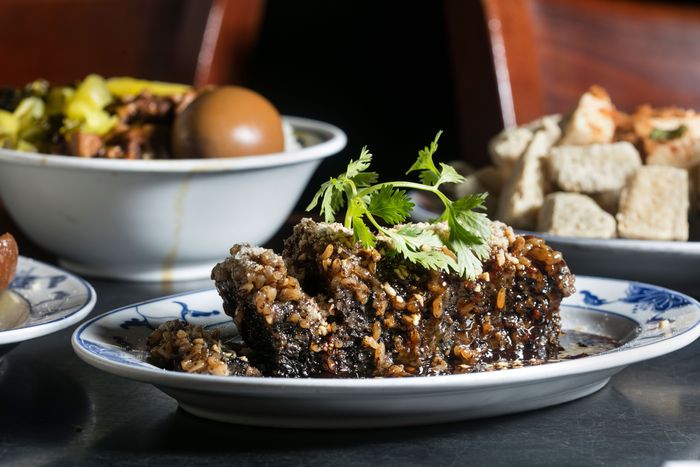
“My go-to neighborhood restaurant is Taiwanese Gourmet. It’s been open for a very long time in Elmhurst and they offer classic Taiwanese dishes like stinky tofu, braised pork over rice and fermented cabbage, and oysters pancakes. They also close late at night, which makes it easy for restaurant people to go to after work.” —Tom Naumsuwan,chef, Wayla
Taiwanese Gourmet’s braised pork is a favorite of Wayla chef Tom Naumsuwan. Photo: Melissa Hom
Flushing
“Alley 41 feels like an old-style home in China. I like to order the intestines with pepper — the outside of the intestine is crispy and the inside is juicy with hints of spice. It’s so good. I also enjoy the sliced pork belly with garlic sauce and cold noodles, and the cauliflower pot. Very flavorful!” —Jimmy Lau, chef-partner, Shuko
Gramercy
“My go-to restaurant not only in Gramercy but in NYC in general is Casa Mono. I’ve been going there for more than ten years and it never disappoints. My staple dish is the ensalada Mono — it’s sweet, salty, cheesy perfection! Everything else on the menu is delicious; you really can’t go wrong.” —Ashley Rath, head chef, LaLou
Greenpoint
“Archestratus Books, a cozy, food-centric bookstore just down the block from my apartment, is a truly unique community space utterly devoted to its Greenpoint neighborhood. Not only do they sell every cookbook you could ever imagine, but at the back of the shop hides a mellow café that serves lovely Sicilian-inspired pastries and delicious snacks like arancini stuffed with basil pesto. They also program really cool neighborhood events centered around the love of cooking and feeding others.” —Natasha Pickowicz,pastry chef, Café Altro Paradiso and Flora Bar
Harlem
“I love Babbalucci. It’s an Italian restaurant with amazing wood-fired pizza and great drinks. The staff always makes you feel welcome and wanting to come back. I like their outdoor seating for a late-night glass of red wine and one of their salads. My favorite one right now is the chicory with burrata. There are so many places to try, but I keep on coming back here.” —Emma Bengtsson,executive chef, Aquavit
Hell’s Kitchen
“My absolute favorite neighborhood spot to frequent on my days off is La Salle Dumpling Room. After making pasta all day long, dumplings always hit the spot. My go-to order is the pork with kimchee xiao long bao. It’s one of the best-tasting soup dumplings I’ve had, and the kimchee gives it that ‘wow’ factor.” —Andrew Whitney, executive chef-partner, Dell’anima
Long Island City
“The Court Square Diner is my go-to for a large OJ with ice and a BLT. Since it’s right around the corner from PS1, where my new project will be, it’s become my second office. The speed at which you get seated and served is diner magic at its best.” —Mina Stone, chef-owner, Mina’s at MoMA PS 1
Lower East Side
“Bacaro is an Italian restaurant in my neighborhood that has great, delicious food without being too froufrou. The specials are always good, too. I had a low-key birthday dinner in their downstairs area that has great ambience with exposed brick and arches that makes it feel like an underground wine cave. They have a really nice wine list with reasonable prices for amazing wines. It’s marvelous!” —Eder Montero,chef, La Vara
Maspeth
“O’Neill’s is a mix between a sports pub and a family restaurant. It is a place we like to go as a group from Ole & Steen because they have a great selection of beers and a nice and simple menu. The waitstaff is very accommodating and they also have great live music on some Fridays and weekends.” —Søren Nissen, baker, Ole & Steen
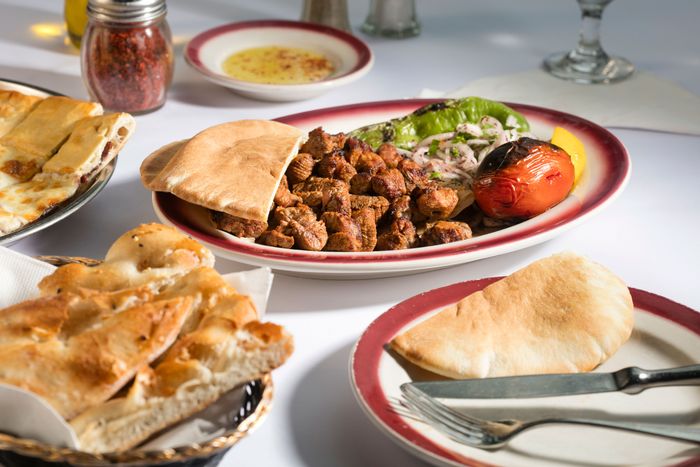
The spread at Turkish spot Taci’s Beyti in Midwood, Brooklyn. Photo: Melissa Hom
Midwood
“Taci’s Beyti is a bustling Turkish restaurant on Coney Island Avenue. On any given day, you’ll see a full dining room hosting families and large groups. They have all the classics that one would expect: stuffed grape leaves, roasted eggplant, cacik (which is a yogurt sauce made with dill and walnuts), lentil soup, pide and kebabs. But I highly recommend getting one of their pides. It’s a torpedo-shaped stuffed bread with cheese and herbs; they offer them with a variety of interesting toppings like filet mignon and peppers or pastrami.” —Thomas Romero,executive chef, ACME
Nomad
“Most Korean food in the U.S. is more spice-driven and stimulating. At O:N, the Korean cuisine it serves is not stimulating in the commercial sense, but more like a home-cooked meal. Two of my favorite dishes on the menu are the sam-gye bab and sam-gye tang, a traditional, restorative chicken soup, especially in the summer season. It swear it helps restore the body.” —Junghyun Park, chef-owner, Atoboy and Atomix
Park Slope
“Faros is a Greek restaurant that takes up the interior of an entire brownstone, giving it the feeling of having dinner at your parents’ house, or maybe that’s because of the little old lady who walks back and forth through all the tables, not even pretending to hide her stares while she watches you, making sure you eat every last bite. Whatever the reason, for me it comes down to the food. I don’t expect an elaborate display of tweezered, never-been-heard-of-before ingredients, nor do I want one. When I come here, I get intensely flavorful, traditional Greek dishes: a side of peeled and boiled potatoes that are glazed so many times in lemon and butter they form glasslike crusts, or a slow-braised octopus with citrus and capers. The piles of cheese they light on fire tableside and endless shots of ouzo keep me coming back.” —Kimberly Plafke,chef, Grand Army
Prospect Heights
“Olde Brooklyn Bagel Shoppe has the best bagel sandwiches. My favorite is the Flatbush with breaded chicken, Pepper Jack cheese, hot sauce, lettuce, tomato, and mayo on a toasted everything bagel. They also sell classic NYC bodega treats, so you can get everything you need in one stop — plus the cashier always calls me “love,” which makes me feel all warm and fuzzy inside.” —Amanda Wilson, culinary lead, Daily Provisions
Red Hook
“Pizza Moto is tasty, casual, and really welcoming. During construction they apparently found an old bread oven behind the walls, so they now use it to make delicious Neapolitan-style pizzas. They change the menu all the time, and my current favorite pie is the Vermonter: white pizza with chili, ham, and maple syrup.” —Joe Ogrodnek,chef, Floret
Soho
“Saigon Vietnamese Sandwich Deli is my favorite real-deal Vietnamese deli. The classic bánh mì paté (paté, thịt nguội, chả lụa) is incredible, and everything a bánh mì should be — super fresh, crunchy-soft, and salty. Every time I order it there, I feel like being transported back to Hanoi, eating a bánh mì while riding sidesaddle on a scooter, racing through the streets. They also do an incredible one with sardines as well as one with pork meatballs and water chestnuts. What’s not to love?” —Robert Marchetti, co-owner-chef, Gran Tivoli and Peppi’s Cellar
South Slope
“When we were opening Lot 2, I was taken to Luigi’sand I knew right away I wanted Gio, the preeminent pizza man and second-generation proprietor, to like me. I wanted to be accepted into his community where it didn’t matter if you were born and raised in the neighborhood, an immigrant, or a hipster transplant, you could get the best slice in NYC and listen to him hold court — as long as you act right. Ten years and a couple thousand slices later, Gio says he considers my 4-year-old son to be family. I couldn’t live up the street from a better restaurant anywhere in the world.” —Daniel Rojo, chef-owner, Lot 2
Go for the cold ramen at Nana while it’s still warm out. Photo: Melissa Hom
Stuyvesant Heights
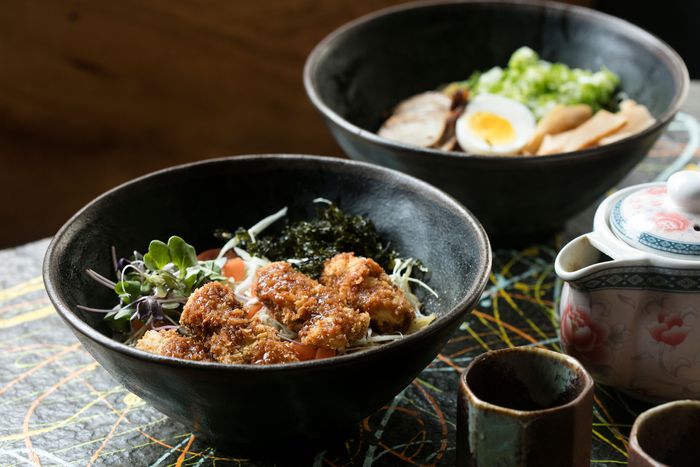
“Nana Ramen is this cute little ramen spot that you wouldn’t notice as a passerby. But once you discover it and decide to go inside, you’ll find delicious ramen. They also do a really nice cold ramen that is super refreshing in the summer. I love it! So good for a little spot in the middle of Brooklyn.” —Ashley Eddie,executive chef, Santina
Sunset Park
“Tacos El Bronco is one of my favorite places because it has a homey, unfussy vibe, and I also love that they offer less traditional (at least in NYC) taco options like veal head, beef tongue, and tripe. Personally, I love to get the beef-tongue tacos and veal-head tacos with guacamole. They are small enough to make a great snack, but are packed with flavor. Head tacos may sound a bit extreme, but this place makes some of the best in the city.” —Will Ono, chef, East One Coffee Roasters
Upper East Side
“Marinara Pizzeria has become my before/during/after pizza snack/slice for any hunger pangs that may hit me. It’s not the best pizza in the world, but it’s damn good. Always consistent and quick and easy; I love having a reliable slice right next to my apartment.” —Jordan Andino, chef, Flip Sigi @ VERSA
Upper West Side
“Coppola’s West is a rustic, Italian red-sauce joint down the street from where I grew up. The entrance is small and down a few steps, but it’s crowded with over-the-top decorations that feel super homey. The food is memorable, but it’s the atmosphere that keeps me coming back. Bring a date, grab a booth along the wall, and share some of the homemade pastas, especially the tortellini. It worked for me in high school and it still does the trick for me today.” —Will Edwards, chef, Gertie
Washington Heights
“I discovered Manolo Tapas because of the live music they have on weekend nights. Even though I’m from France, a large portion of my family is Spanish and all the dishes and music at Manolo Tapas remind me of my childhood vacations in Spain. Some of my favorite things to eat there are the boquerones a la vinagreta and the fresh manchego cheese.” —Lucile Plaza, executive chef, Le Coq Rico
West Village
“A neighborhood classic that I love returning to again and again is Rockmeisha, a small Japanese izakaya on Barrow Street. It was a regular hangout post-shift when I worked nearby, and I still love stopping in today, whether it’s for a bowl of ramen or their excellent pork-katsu sandwich. It’s cozy with a vintage jukebox and rock band décor. They have a small TV, which often is playing old movies or wrestling. I always feel welcomed there, and it’s a great spot to catch up with friends while drinking a Sapporo and sake.” —Mary Frances Attea,chef, High Street on Hudson
Williamsburg
“Suzume has long been a go-to restaurant of mine. It’s an easy place to be, and I find it good for a solo meal or a date night in the neighborhood because it’s warm and inviting and pulls off a small menu with a lot of different options. They have a solid cocktail menu as well, and I like that I can go time after time and mix in some favorites like the spam musubi, salmon ramen, and poke sushi while trying new dishes and drinks to keep it interesting.” —T.J. Steele,chef-owner, Claro
Windsor Terrace
“My wife and I like Krupa Grocery because it’s super quaint and kid-friendly. They have a large pickup window with an open kitchen that my daughter never gets tired of looking at and mentioning how hot it is near it. There is also a patio outside that is really private and a great place to escape the afternoon sun and grab a drink and snack. The food is simple, delicious, and changes enough to feel seasonal.” —Brian Lockwood, chef de cuisine,Eleven Madison Park